
Sanctuary in the Ash
Albedo, Lunar Work, and the Grimoire of the Queer Male Soul

Caput I: Proemium Albedinis
The Cooling of the Furnace
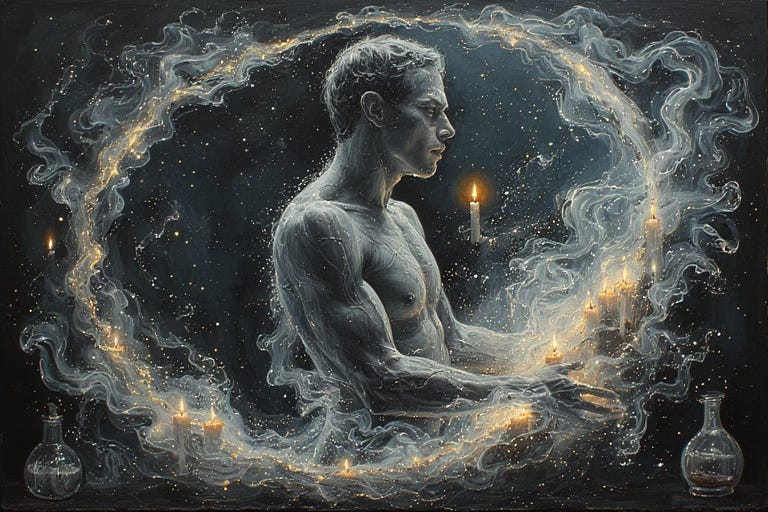
The fires of Nigredo—those crimson-orange tongues that licked at the walls of your psyche—do not burn forever. There comes a moment in the alchemical opus when the fuel of the old ego, that brittle kindling of false identities and defensive postures, is finally exhausted. The screaming of the psyche quiets to a whisper, then to silence—not because the pain has vanished like morning mist, but because the transformation has reached its critical threshold, like mercury climbing to the top of a thermometer before the glass shatters. The obsidian vessel, once vibrating with the heat of putrefaction and the humid stench of decay—that green-black odor of compost and forgotten dreams—begins to cool, its surface no longer painful to touch. The heavy, sulfurous smoke that choked the laboratory, that burned the eyes and coated the tongue with bitterness, settles like dust after a storm, revealing a landscape that has been utterly changed: bones where there was flesh, crystal where there was mud.
This is the arrival of Albedo, the Whitening—the silver dawn after the longest night.
If Nigredo was the descent into the swamp—the moist, chaotic, swarming darkness of the prima materia where mosquitoes of doubt feasted on exposed flesh and the stench of decay clung to every thought—then Albedo is the ascent onto the glacier’s vast crystalline expanse. It is a shift in elemental register so profound that it can feel, at first, like death: lungs burning with each inhale of rarified air, fingertips numbing, heartbeat slowing to preserve warmth. The heat of the passions, the fever of the shame, the burning inflammation of the wound—all of it withdraws like tide from shore, leaving behind hollowed shells and glittering salt crystals. In its place comes a stillness as sharp and brittle as winter air that cracks the skin and transforms breath into clouds of ephemeral geometry.
For the Queer Male Alchemist, this transition from scorching heat to crystalline cold is often as disorienting as stepping from a sauna directly into an Arctic lake. We are so accustomed to the heat of the struggle—the sweat-slick skin of resistance, the parched throat of protest, the flushed cheeks of righteous anger. Our identities have been forged in the fires of opposition; we know ourselves through the burning of the closet with its splintering wood and choking smoke, the fever-dream of desire with its midnight sweats and morning-after aches, the inflammation of societal rejection that spreads like a rash across our sense of self. We have learned to equate “aliveness” with intensity, with the constant friction of survival that leaves calluses on our souls. When the silence of Albedo descends—a silence so complete it rings in the ears like the aftermath of an explosion—it can feel like an abandonment. The drama of the shadow stops mid-scene. The demons that tormented us in the dark do not vanish, but they freeze into ice sculptures, exquisitely detailed statues of our former torments, silent and observable beneath a layer of frost.
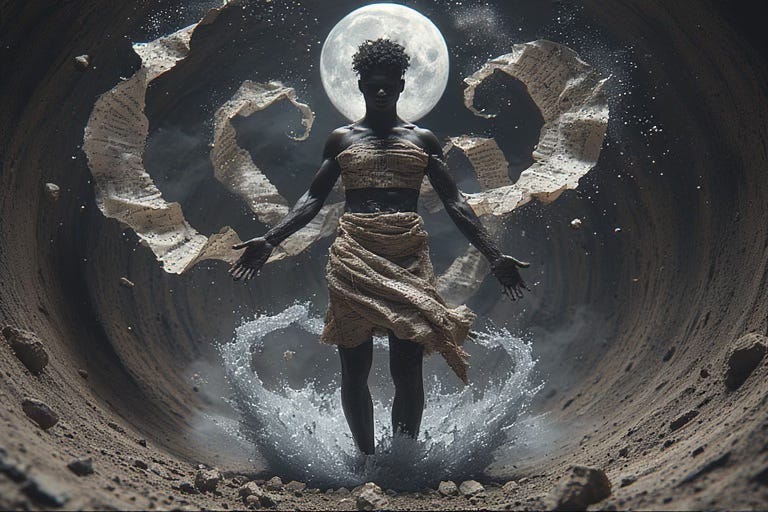
This phase embodies the Separatio—the sacred alchemical operation where gossamer spirit untangles from leaden matter, like morning mist rising from dark waters. In Nigredo, everything commingled in unholy union: the sweet nectar of pleasure dissolved in bitter pain, tender love entangled with venomous hatred, ethereal spirit imprisoned within sweating flesh—all churning together in a viscous, tar-like sludge that coated every thought. Albedo arrives as the crystalline dawn of discrimination, when quicksilver clarity parts the obsidian waters. It is the precise moment when the Queer Alchemist, lungs burning and limbs exhausted, breaks through the surface of his own drowning ocean and plants his trembling feet upon the luminous White Earth (Terra Alba). His bare feet leave perfect impressions in the ash-like soil. He stands erect, shivering but clear-eyed, no longer the victim of his own chaotic substance but the silver-pupiled observer of it.
The White Earth (Terra Alba): The Holiness of Ash
To understand Albedo, we must understand the nature of Ash. Run your fingers through it—this powdery residue, silver-white and weightless as moondust, soft as talcum yet somehow eternal. When the Nigredo fire has consumed everything that can be burned—the false personas with their brittle masks, the internalized homophobia with its poison-tipped arrows, the desperate need for validation that once howled like a starving wolf, the attachments to trauma that clung like burrs to the soul—what remains? What is left at the bottom of the crucible when the blackness has burned itself out and the last ember fades to gray? This luminous dust, this incorruptible essence, this sacred powder that no flame can touch again. Ash remains.
In the chemical worldview, ash is merely waste—a gray-white residue swept away from hearths and laboratory floors, worthless except as lye for soap or fertilizer for fields. But in the alchemical worldview, ash is the Terra Alba, the White Earth—a luminescent powder that catches moonlight like crushed diamonds and feels like velvet between the fingers. It is the most sacred substance in the Work because it is incorruptible, having already passed through the crucible’s inferno. Flesh can rot, becoming putrid and green-black with decay. Wood can rot, softening into damp, insect-riddled pulp. Even stone can erode, surrendering to water’s patient tongue over centuries. But ash cannot be burned again. It rests in alabaster silence, having already surrendered to and survived the ravenous orange flames. It has been purified of all volatile elements, all moisture, all susceptibility to decay—leaving only the essential, immortal quintessence.
For the Queer Man, attaining the state of “Ash” is the goal of the first half of the opus. Imagine standing barefoot in a circle of this luminous powder—fine as talcum, cool as moonlight against your skin, each particle a microscopic mirror reflecting your truest face back to you. This is the core of selfhood that remains after society’s bonfire has exhausted itself. The world can only burn what is flammable: your reputation crumbling to cinders in the mouths of others, your safety evaporating like alcohol in flame, your relationships charred at their edges until they disintegrate. But it cannot burn the Ash of your essential nature—this silver-white residue that slips through fingers like quantum particles, simultaneously weightless and containing the entire universe of your being.
This “Whiteness” must be sharply distinguished from the “Purity” demanded by religious or heteronormative structures. The Purity of the Church is the whiteness of whole milk poured into crystal stemware—naive, untested, fragile, easily curdled by a single drop of lemon juice. It is a purity that relies on high walls and locked gates, on the suppression of the body’s midnight whispers, on hands scrubbed raw with lye soap rather than risk touching the fertile loam of existence. The Whiteness of Albedo, by contrast, is the alabaster luminescence of a skull bleached by desert sun, the pearlescent gleam of a femur polished by time. It is the silver-white radiance of the full moon reflecting off the raised ridge of an old knife wound, transforming trauma into topography. It is a purity that has been earned through the ordeal of the fire—not the sanitizing flame of the censor, but the devouring inferno that reduces everything to essential elements. It is not the wide-eyed innocence of the child who knows nothing of the world’s shadows; it is the “Second Innocence” of the Sage who has mapped every inch of those shadows—who has tasted the bitter mud of despair, swallowed the salt-sweet semen of desire, and licked the metallic blood of his own wounds—and has washed himself clean in the moonlit pool not to deny his history, but to transmute it into sacred text.
The Queer Alchemist in Albedo stands barefoot on the white earth, his skin luminous in the silver moonlight. His palms open toward the sky, revealing ash-dusted fingertips that once clutched desperately at dogma. With eyes clear as mountain pools, he does not proclaim, “I have never sinned.” Instead, his voice—steady as a temple bell at midnight—declares, “I have burned away the concept of sin itself, watched it blacken and curl like parchment in flame, until only this remains.” He extends his hands, where something gleams between his fingers: not the dull gold of church ornaments, but the living gold of authentic selfhood, a substance both weighty and luminous that catches the moonlight and throws it back sevenfold.

The Lunar Principle: The Re-Membering of the Inner Woman
As the solar heat of the Nigredo fades—that scorching, masculine fire that burned away illusions in a crucible of pain—the silvery, reflective light of Albedo now rises like moonbeams across still water. In the yellowed parchment of traditional alchemical manuscripts, this transition appears as the enigmatic Rebis or Hermaphrodite figure: a single body with two faces, one masculine and one feminine, its right hand clutching the blazing Red Sun while its left cradles the luminous White Moon against a starry indigo background. For the Queer Male who has survived the burning, this arrival of the Moon’s cool radiance forces a trembling confrontation with what patriarchal masculinity has declared the ultimate taboo: the undeniable presence of the “Femme” within his own psyche—those parts of himself he was taught to excise like tumors from his being.
The “Inner Woman”—the Soror Mystica (Mystical Sister) or Anima—shimmers within the Queer Alchemist like moonlight on water. She is not a gender identity in this context, but an energetic principle that moves like silver mercury through the veins. She manifests as the palm that opens to receive rather than the fist that strikes; as the ear that listens for whispers beneath the thunder; as the body that flows with tidal rhythms rather than marching to mechanical time. Patriarchy, and the “Masc4Masc” culture that mimics it with its gym-sculpted armor and carefully deepened voices, demands the surgical excision of this Lunar essence. It commands a masculinity that is purely Solar: thrusting and penetrative like the sword, constant and unchanging as desert noon, unyielding as sunbaked clay, dry as a rainless season, and relentlessly active like a heart that cannot rest. It views the Lunar as a threat—moist as morning dew on petals, changing as cloud formations, emotional as a violin’s highest note, “sissy” as the delicate unfurling of fern fronds in spring forest.
In Nigredo, the Queer Man often battles this internal Lunar force with the ferocity of a medieval crusader. He sculpts his deltoids and biceps into armor at the gym, each repetition a denial of the softness beneath muscle. His voice drops an octave in public spaces, the natural lilt of his speech compressed into a gravel-filled register that scrapes his own throat raw by day’s end. His tears become contraband, smuggled only into shower stalls where they can dissolve unwitnessed. Each emotion—tenderness, vulnerability, yearning—becomes a prisoner of war, bound and gagged in the dungeon of his psyche. He is at war with the Moon, her silver face reflecting back everything he has been taught to exile from himself. But Albedo is the Moon herself—not just her light but her entire being: her tidal pull, her cyclical wisdom, her reflective surface that refuses to lie. You cannot enter this stage without surrendering to her luminous embrace that bathes everything in mercurial clarity.
To enter Albedo is to lay down arms in a war that has raged since childhood. The queer man’s body—once rigid with vigilance, muscles tensed like a drawn bow—softens its contours, hollowing itself into a vessel that receives rather than pierces. His hands, which once curled into fists at the first hint of vulnerability, now open like silver bowls catching moonlight. The Solar force—that blazing, directional energy that propelled him through hostile hallways and across dance floors with performative confidence—now pools and settles within the curved walls of his Lunar nature. His tears, no longer shameful evidence of weakness, become alchemical waters that dissolve calcified barriers between heart chambers. The “femme” qualities he once buried beneath layers of affected masculinity—the intuitive tremor that registers emotional undercurrents in a crowded room, the receptive silence that invites confession, the gentle hand that knows precisely where to touch—emerge like buried treasure, their silver surfaces catching light after years in darkness. The “sissy” boy who was punished for seeing too much, feeling too deeply, and moving too gracefully now stands revealed as a silver-tongued prophet whose sensitivities were not flaws but sophisticated instruments calibrated to detect frequencies beyond the range of patriarchal hearing.
Ablutio: The Great Washing
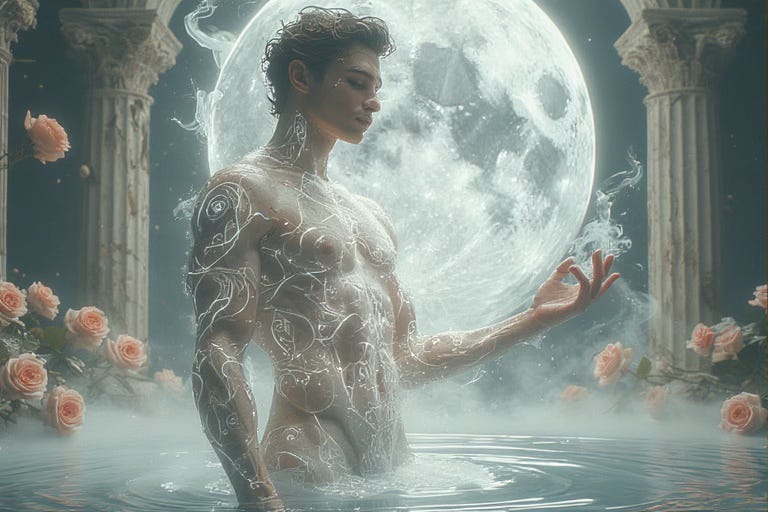
With the cooling comes the cleaning—a ritual as delicate as morning dew collecting on spider silk. The central operation of Albedo is Ablutio (Washing) or Baptisma (Baptism), where mercury-bright waters cascade over calcined matter. But this is not the baptism of the priest who sprinkles tepid holy water from a silver aspergillum to “save” you from your nature. This is the baptism of the Alchemist who submerges the blackened prima materia completely in a moonlit basin until it emerges dripping with possibility.
In the Nigredo, we wallowed in obsidian muck. We had to. We had to feel the full weight of our depression pressing down like wet wool, our rage crackling like pitch in flame, and our desire coiling like smoke around our throats. We were covered in the “Black Gum” or “Pitch”—that tarry substance that stuck to our fingers, matted our hair, and sealed our eyelids with its viscous darkness. Now, the instruction whispers from ancient parchment: Lavate ignem (Wash the fire).
This is a psychological scrubbing, meticulous as a silversmith polishing tarnished heirlooms. We take memories encrusted with shame’s black patina—memories that cling like oil-slick residue to the skin of our consciousness—and immerse them in the crystalline solvent of objective understanding. Consider that first sexual encounter: in Nigredo, this memory burns hot as molten lead, sticky as pine resin between fingers, dark as an unlit confessional booth. The memory reeks of sweat-dampened sheets hastily hidden, of cologne applied too heavily to mask the scent of another man’s skin, of mint gum chewed frantically to erase the taste of forbidden kisses. In Albedo, we perform Ablutio with the precision of a ritual. We wash each memory as meticulously as ancient priests washed sacred vessels—removing, layer by layer, the accumulated grime of societal context: the thundering pulpit sermons that promised hellfire, the dinner table silences that followed AIDS reports on evening news, the whispered slurs in high school hallways. These contaminants of the psyche will all slough away like dead skin until we can examine the naked act with silver-clear eyes.
After the cleansing, what essence remains? Just this: bodies meeting bodies. Skin finding skin. The electric current of pleasure arcing between nerve endings. The ancient human quest for union with another. Once the cultural sediment settles away, what society labeled “transgression” reveals itself as merely existence—a natural phenomenon as elemental as rain meeting earth. Like quicksilver pooled in your palm, it catches the light without judgment. No longer something to carry with shame, but simply a luminous fragment in the mosaic of your becoming.
This washing extends to the body itself. The Queer Alchemist in Albedo often develops a fascination with hygiene, but not the neurotic hygiene of the obsessive-compulsive. It is a ritual hygiene. The shower becomes a temple where steam rises like incense, water cascades over shoulders in silver rivulets, and each droplet carries away microscopic particles of the old self. The application of oil becomes a sacrament—fingers tracing sacred geometries across the terrain of skin, amber liquid catching light as it transforms from gloss to velvet absorption. The grooming of the beard or the hair becomes a way of polishing the statue, each snip of scissors or stroke of the razor a deliberate act of reverence for the vessel that survived the fire.

The Silence of the White Chamber
Nigredo is a noisy stage. It is the sound of the closet door slamming shut with the finality of a prison cell, the muffled weeping into a pillow damp with midnight tears, the relentless bass thumping through sweating bodies in a nightclub at 3 AM, the raw-throated shouting at protests under placards held by trembling hands, the guttural sounds of anonymous sex in darkened rooms that smell of desperation and cologne. It is the cacophony of a soul breaking open like a geode split by a hammer, revealing both jagged edges and crystalline beauty. Albedo, by contrast, is defined by a Silence as profound as fresh snow at dawn—not empty, but filled with the suspended potential of everything unsaid.
This is the silence of the library at 2 AM, where leather-bound spines exhale centuries of dust in the lamplight. It is the silence of the laboratory where mercury beads scatter across white porcelain with a whisper. It is the silence of the monastery where stone floors remember the padding of bare feet across their cool surfaces for a thousand years. The Queer Man entering Albedo often feels a sudden, inexplicable need to withdraw, as if invisible silver threads are pulling him inward. The “Scene”—the bars with their sticky countertops and bass that reverberates in the sternum, the dating apps with their endless scrolling gallery of torsos and faces that blur together like watercolors left in rain, the exhausting social circuit of brunches where mimosa glasses clink and conversations repeat like scratched vinyl—suddenly feels not just exhausting but actively abrasive. The noise of it grates on the nerves like sand in silk sheets. The “White Noise” of validation-seeking (the ping of the message that makes the heart leap before the mind can intervene, the dopamine hit of the like that floods the brain with momentary warmth before receding like a tide) loses its flavor like chewing gum that’s been in the mouth too long.
The queer alchemist withdraws into his Camera Obscura—that darkened chamber where external images project themselves inverted and luminous against interior walls. This retreat might once have felt like exile, a return to the suffocating closet where invisibility meant non-existence. Yet in Albedo, invisibility becomes a conscious choice—not concealment but chrysalis formation. Wrapped in silence like silver thread spun into a white cocoon, he discovers something remarkable: when the cacophony of the Nigredo phase finally quiets, another voice emerges. The Anthropos, that inner authentic self, begins to resonate. Its voice—previously drowned beneath Nigredo’s cacophony—vibrates with the delicate clarity of a silver tuning fork struck in an empty cathedral. In this cool white stillness, what was once merely whispered now becomes song.
The Trap of the Silver
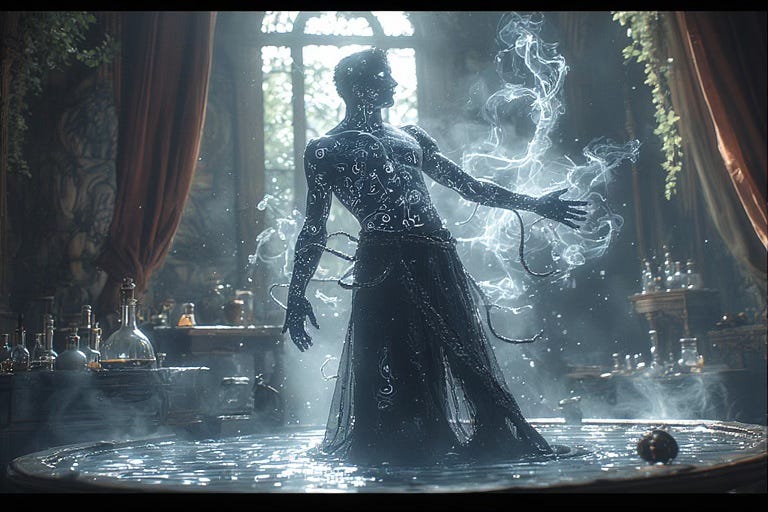
Each phase of the alchemical journey carries its own particular venom. Where Nigredo poisoned with despair, Albedo threatens with its crystalline detachment. Here lies the paradox: having survived the fire and scrubbed away the soot, the Alchemist may grow too enamored with his newfound clarity. The danger manifests when he retreats so completely into pristine understanding that he ceases to engage with the messy vitality of existence. He risks becoming what the philosophers called “The Beautiful Soul”—that being who floats above the messy terrain of human experience, too purified to touch the earth again. Such an Alchemist stands apart from life’s procession, analyzing its movements without feeling its rhythm. Like mercury in a sealed vial, he reflects everything perfectly while touching nothing. The ultimate danger: becoming the “Ice Queen”—a flawless silver mirror, unblemished, untouchable, and utterly cold.
Terra Alba offers no sustenance. The pristine whiteness of calcined matter, though immaculate, remains as infertile as moonlight on marble. This explains Albedo’s position as intermediary rather than culmination. We cleanse the laceration not to preserve its sterility but to prepare it for regeneration. We reduce the temperature of heated metal not to abandon our craft but to ready it for the final striking. As a Queer Alchemist, you’ve earned this lunar respite. Let silver light wash over you; allow silence to mend your frayed nerves. Yet remember—your journey’s end is not crystallization into immobile purity. Your destiny lies in becoming not a pillar of salt, but the Philosopher’s Stone itself—alive with possibility. Already, at the horizon of your consciousness, the crimson sun of Rubedo waits to rise, ready to warm this white desert and coax new life from apparent barrenness.
For this moment, though, allow the crucible to grow cool. Welcome the white silence that blankets your consciousness like fresh snow. Trust in the quietude to complete what flame has begun.
Caput II: The Silvered Mirror and the Twin
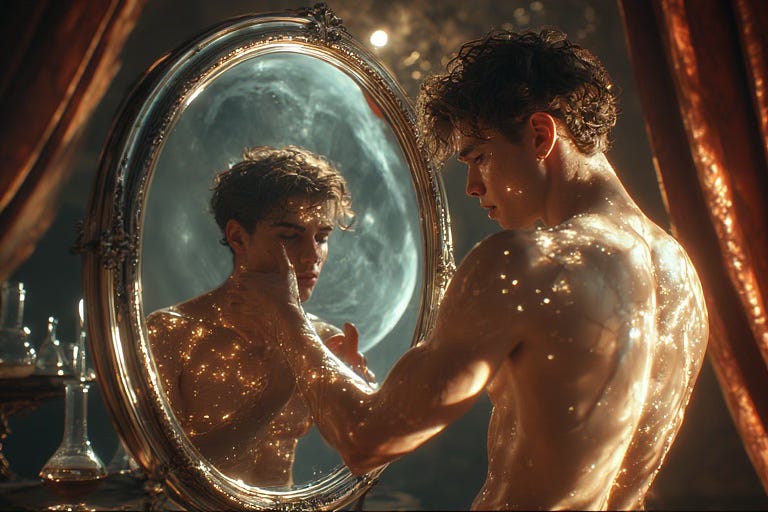
The Speculum Alchemiae: Reclaiming the Glass
In the inventory of the Alchemist’s laboratory—alongside the obsidian-handled athame with its silver blade, the silver-rimmed chalice that catches moonlight like water, and the iron crucible scarred by a thousand fires—there sits an instrument often dismissed as a tool of vanity: the Mirror, its surface a pool of quicksilver trapped in an ornate frame of silver filigree, waiting to reveal either monster or god to the one brave enough to truly look.
In the profane world, the mirror is a merciless judge with cold, unblinking eyes. For the Queer Male, historically, it has been an instrument of exquisite torture—a silvered guillotine for the soul. Standing before it at thirteen, breath fogging the glass, you searched for the “tell”—the too-delicate flick of the wrist that your father had already mocked, the softness of the jaw that hardened boys at school had punched, the particular sadness pooling in the eyes that seemed to mark you as prey. Later, it became the clinical surface against which you scrutinized your body for the purple-black lesions of the plague during the crisis years, tilting your naked form in the bathroom light, heart hammering as you examined each mole and blemish. Later still, it reflected back every “imperfection”—the insufficient definition of the abdomen, the asymmetry of the face, the shoulders not quite broad enough—that might render you invisible in the brutal, gleaming marketplace of modern desire, where bodies are displayed like cuts of meat behind glass. We learned to look at the mirror, but rarely into it. We scrutinized its reflective surface for the slightest imperfections—a pimple rising like Vesuvius on our chin, the asymmetrical curve of our jawline, the softness gathering at our waistline like unwelcome guests. We searched for safety, scanning our bodies for telltale signs that might mark us as targets. We assessed our currency in the marketplace of desire, calculating our worth in millimeters of muscle and angles of bone structure.
But in Albedo, the mirror transforms. The silvered glass, once cold and accusatory, liquefies into something living and luminous—the Speculum Alchemiae, the Mirror of the Art. The instruction of this stage arrives like a whisper against the nape: Inspice in speculum mentis (Look into the mirror of the mind).
The Albedo stage is dominated by the element of Silver—that mercurial metal that catches moonlight and transforms it into liquid brilliance. In the alchemist’s workshop, a polished silver disc gleams on the wooden table, so perfectly burnished that when you pass your hand above it, you can see each whorl of your fingerprint reflected with crystalline clarity. Unlike gold’s hungry absorption of light, silver refuses to consume; it offers back every photon that touches its surface with almost perfect fidelity. For the Queer Alchemist, “Silvering the Mirror” means painstakingly cleaning the perception of the Self—scrubbing away the accumulated tarnish of societal projection with fine chalk powder, wiping clean the steam of shame that fogs the glass after every hot breath of desire, and brushing away the microscopic dust of dysmorphia that settles daily, until the mirror returns an image so accurate, so neutral, and so luminous that it feels like gazing into a still mountain lake at midnight.
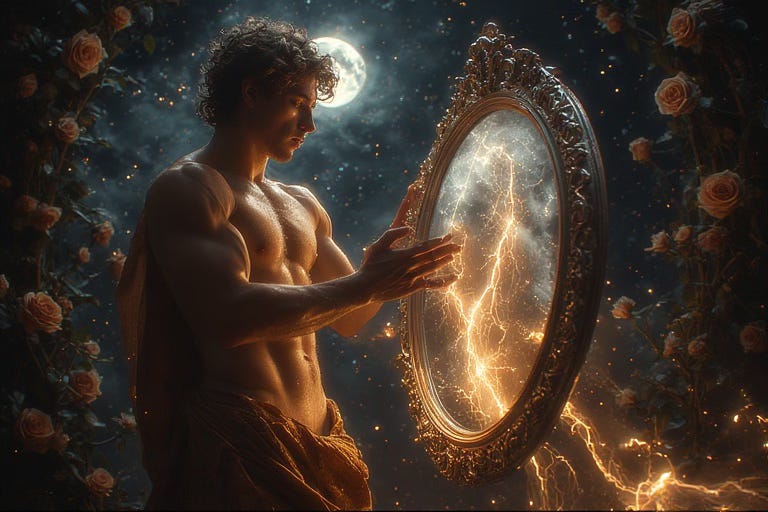
Narcissus Redeemed: The First Alchemist
To understand the Mirror Work of Albedo, we must first rescue the patron saint of mirrors from his prison in moralistic mythology: Narcissus. Picture him: the youth with olive skin and dark curls falling across his forehead, kneeling at the edge of a forest pool. The water’s surface gleams like polished silver beneath the dappled light filtering through oak leaves. His reflection—those full lips parted in wonder, those amber eyes widening with recognition—trembles with each breath he takes. We have been told his story as a cautionary tale against homosexuality and vanity. A beautiful boy falls in love with his own reflection and wastes away because he cannot possess it, his body eventually dissolving into the golden trumpets of the flowers that now bear his name. “Don’t be like Narcissus,” the culture warns with wagging finger. “Don’t look at yourself too long. Don’t love yourself too much.”
But the Queer Grimoire reads the myth differently, its silver-inked pages illuminated with images of pools reflecting moonlight. Narcissus—olive-skinned, dark-eyed, with a mouth soft as new petals—did not die because he loved himself. He died because he did not recognize his own divinity staring back. The face wavering in the still forest pool, haloed by dappled sunlight filtering through leaves, appeared to him as an “Other”—a beautiful stranger with cheekbones sharp as cut crystal, a potential lover whose lips promised secrets, a woodland god crowned in shadow. When he reached out, fingers trembling with desire, the water’s silver skin rippled, fracturing the beloved face into a thousand shimmering pieces. He died of that separation, his body withering like cut flowers as he knelt by the water’s edge. He died of the heartbreaking chasm between the I who yearns and the Image that cannot be grasped.
This is the tragedy of the uninitiated Queer Life. We spend years—decades—hunting for the “Beautiful Stranger.” We scour the apps with their glowing grid of torsos, tthe bars with their blue-violet lighting that transforms ordinary men into ethereal beings, the bathhouses with their labyrinthine corridors of steam and shadow, looking for Him. The one whose touch will transmute our lead into gold. The one who possesses the magic in his calloused palms, the masculinity in the salt-musk scent at his throat, the one who will complete us. The one whose broad shoulders or clever hands or deep laugh possesses the precise magic, the exact shade of masculinity, the particular beauty, the specific wholeness that we feel we lack. We fall in love with men whose laughter comes easily, whose bodies move through space without apology, who wear their desires like well-fitted garments rather than ill-concealed wounds, men who have the qualities we have disowned in ourselves—their confidence as they move through a room, their ease in their bodies, their comfort with desire.. We project our own Golden Shadow onto them like gilding a statue.. We are Narcissus kneeling by the pool, fingertips trembling just above the water’s silver skin, reaching for a reflection we mistake for a lover.

The Albedo Redemption: Finding the Inner Silver
The Albedo moment arrives when the Queer Alchemist stops reaching. His outstretched fingers hover above the mirrored pool, trembling with desire, then slowly withdraw. He exhales. The ripples on the water’s surface—concentric rings of silver light—gradually dissipate until the pool becomes a flawless looking glass again. The image returns with crystalline clarity: dark eyes meeting dark eyes across the impossible boundary between worlds. And suddenly, the realization strikes like a bolt of silver lightning that illuminates the entire forest, casting no shadows: Tu es ille. (You are He.) The beauty I have been hunting through midnight streets and backlit screens? It is my own reflection, wearing the face I’ve always possessed but never truly seen. The masculinity I have been worshipping in others—that easy grace of movement, that unapologetic claiming of space? It is my own potency, buried beneath years of careful self-diminishment. The divinity I sought in the bed of the stranger, that momentary transcendence in another’s arms? It is looking at me from my own eyes, patient as the moon that has witnessed every desperate search.
Narcissus is redeemed not by turning away from the pool, but by recognizing the image in its silver-blue depths. His trembling fingers hover above the water as the realization floods his consciousness: “It is me.” The reflection—those dark eyes, those full lips, that olive skin dappled with forest light—is not an Other to be possessed but the Self to be embraced. In that crystalline moment, the separation collapses like a wave returning to the ocean. The longing—that ache that had hollowed his chest for years, always reaching for something outside—transforms into integration, a warm golden light spreading through his limbs as he realizes what has always dwelled inside. The “wasting away” stops; color returns to his cheeks. The Alchemist rises from his knees beside the pool, legs steady now, shoulders relaxed, breath deep and even. He no longer needs to consume the Other to feel complete; he carries the completion within his own skin, a quiet radiance that illuminates him from within.

The Soror Mystica and the Frater Secretus: The Twin Within
In the yellowed pages of ancient alchemical grimoires—their vellum edges crumbling like autumn leaves, their bindings exhaling the musty perfume of centuries—copper-plate engravings reveal the Great Work as inherently collaborative. A robed figure—the Alchemist—with stern eyes and hands stained with sulfurous residue, stands not alone but beside the feminine principle embodied as the Soror Mystica, her diaphanous gown swirling about her ankles like morning mist. The most telling images appear in the Rosarium Philosophorum, where royal figures—Sol with his radiant face and golden crown of twelve points, Luna with her alabaster skin and silver crescent nestled in her flowing hair—submerge in mercurial waters that shimmer like liquid mirrors. Their separate bodies dissolve, flesh melting into quicksilver ribbons, die together in a silent embrace, and rise transformed: one hermaphroditic being with two faces gazing in opposite directions, the Rebis, its right side sun-bronzed and masculine, its left pearlescent and feminine, containing all polarities within a single form that glows with an inner light neither gold nor silver but both simultaneously.
For the Queer Male Alchemist, who often walks the path without a female counterpart in the literal sense, a different figure emerges from the silvered depths. This is the Twin—the Frater Secretus (The Secret Brother)—not merely a concept but a presence with weight and substance. He appears first as a shimmer at the corner of vision, then gradually solidifies: a figure with your exact height but somehow more graceful, your features but somehow more serene, your hands but somehow more capable. This luminous doppelgänger waits patiently on the other side of every reflective surface, breathing when you breathe, moving when you move, yet somehow freer in his skin than you have ever felt in yours.
In the Nigredo, we experienced the Twin as a ghost or a demon, a spectral figure lurking in the periphery of consciousness, his face obscured by a veil of soot, his voice a harsh whisper of self-condemnation. He was the “Shadow Self” who carried our shame like a heavy obsidian stone pressed against his chest. But in Albedo, as the Shadow is washed in the mercurial waters and whitened like linen bleaching in moonlight, the Twin is revealed as the Beloved—his features clarified, his eyes luminous with compassion. This is a profound psychological shift, like the moment when a silver mirror is polished to such brilliance that it no longer distorts what it reflects. The Queer man begins to develop a relationship with his own interiority that feels like a romance—leaving notes of appreciation on his own pillow, setting aside time for intimate conversations with himself, noticing the particular curve of his own smile with the tender attention of a new lover. He begins to “court” his own Soul as carefully as one might approach a shy deer in a forest clearing. This is not masturbatory solipsism, not the narcissist’s shallow pool. It is the necessary restructuring of the psyche, the rebuilding of a temple long desecrated. If you do not have a Loving Twin inside you—a presence whose silver hands can hold your heart without judgment—you will demand that every partner you meet play that role. You will demand that your boyfriend, your husband, or your trick be your Mirror, your Validator, your God, placing upon their human shoulders a burden meant for divine architecture. No human being can bear that weight. They will crack like alabaster statues beneath a hammer.
By finding the Twin within—by establishing a dialogue with the Frater Secretus whose silver eyes reflect back not judgment but recognition—the Alchemist liberates his actual human lovers from the impossible burden of being his Savior. The weight lifts from their shoulders like a heavy cloak being removed. He can now love men for the particular constellations of light and shadow they carry, for the specific cadence of their laughter, for the unique geography of their bodies—not merely for the reflection they provide of his own unmet needs. He enters the “White Marriage” (Coniunctio Alba), a union more profound than any external ceremony could sanctify. In this sacred inner chamber where silver light pools on alabaster floors, he is married to his own truth, crowned with the diadem of self-knowledge. He walks through the world differently now—his footsteps lighter, his gaze clearer. He is never alone, even in the deepest solitude of the Albedo silence, because the Twin is there, breathing in perfect synchronicity with him, a presence as palpable as moonlight on skin.

The Rite of the Speculum: Practice and Danger
How is this achieved practically? Through the Rite of the Speculum—an alchemical mirror-gazing that transforms mere reflection into revelation. This is a terrifying ritual for many queer men who have spent lifetimes avoiding their own image except when carefully posed or partially obscured. It involves standing before a full-length mirror in a dimly lit room where silver-blue moonlight filters through gauzy curtains, confronting the naked body in its raw, unadorned state—without the protective armor of carefully chosen clothing, without the distorting lens of sexual arousal that momentarily transforms flesh into fantasy, without the merciful shadows that usually hide what we’ve been taught to despise.
The Practice: The Alchemist stands before the full-length mirror in a chamber bathed in silver-blue radiance. The lighting caresses rather than exposes—Albedo is the gentle luminescence of the moon, not the merciless interrogation of solar brightness. His naked form emerges from shadow, pale shoulders catching light like marble. The first instinct arrives with familiar venom—the Critic’s Gaze, that Nigredo residue that never fully dissolves. His eyes dart involuntarily to the soft curve of belly where muscle once defined itself, the peninsula of hairline retreating like an ebbing tide, the archipelago of scars mapping past wounds, the subtle asymmetry of shoulders that no one else would notice. The inner voice hisses with practiced precision: “I am too old. I am too fat. I am too skinny. I am not Him.” The Alchemist acknowledges this voice—feels its barbs against his skin—but refuses to engage its ancient argument. Instead, he performs the Ablutio of the gaze, imagining cool water washing over his vision, diluting the acid of judgment until his eyes become neutral instruments. He looks again, breathing deeply into his diaphragm. This time, he seeks the Form beneath the supposed Flaws—the elegant architecture of clavicle and hip bone, the delicate river-map of veins beneath translucent skin, the rich history written in each freckle and line. Then, with deliberate slowness, he raises his focus to the eyes—those pools of amber flecked with gold—and locks gaze with his own reflection. The periphery of the mirror begins to blur and darken as the Troxler Effect takes hold—that curious psychological phenomenon where staring at a fixed point causes surrounding vision to fade. In this liminal space between seeing and dissolving, the “Mask” of his daily persona slips away like silk falling from heated skin. The face in the mirror shifts, flows, transforms—sometimes bearing the high cheekbones of a grandfather he never met, sometimes showing the trembling lips of his eight-year-old self, until finally emerging with crystalline clarity: the face of the Twin—neither young nor old, neither wounded nor perfect, but timeless in its serene recognition. The Alchemist’s lips part, and he speaks the words of recognition, his voice low and resonant in the sacred silence: “I see you. I accept you. I am you.”
The Danger: The danger of the Mirror is dissociation—that seductive slipping away where consciousness detaches from flesh and hovers in the silvered realm beyond the glass. One can get lost in this “Glass World,” preferring the perfected image of the fantasy self to the reality of the meat with all its scars and softening edges. The Mirror becomes a narcotic, a shimmering portal to escape the weight of bones and the inconvenient hungers of the body. This is why the Mirror Rite must always be followed by Grounding—the deliberate press of bare feet against cool stone floors, the taste of bitter herbs on the tongue, the weight of water being poured over the crown of the head. We do not live in the mirror. We visit it to remember who we are, and then we step back into the world of gravity and dirt. The Albedo Alchemist must be careful not to become a “Mirror Prince”—vain, untouchable, constantly checking his reflection in shop windows and polished surfaces to ensure he still exists, his fingers tracing the contours of his face like a blind man memorizing a stranger. The goal is to internalize the Mirror so deeply that you no longer need the glass, so that when you place your palm against your sternum, you feel the silver light pulsing beneath skin and sinew—you carry the sense of your own wholeness in your chest like a lantern.
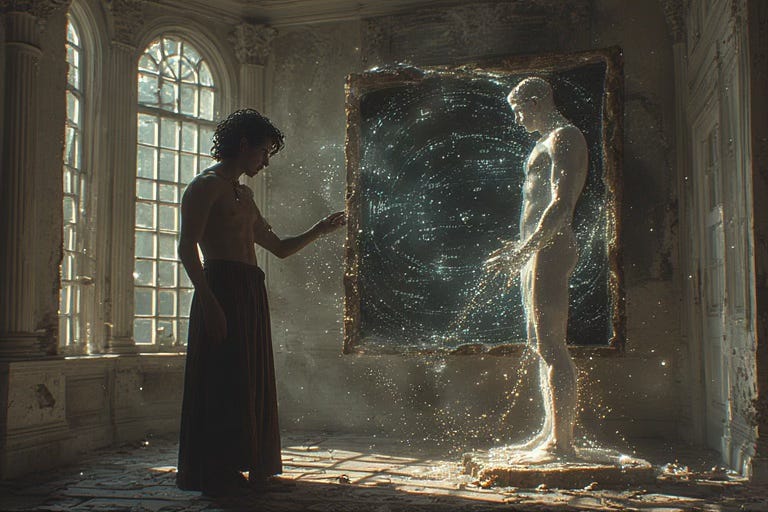
The Silver Thread: Healing the Dysmorphia
Body Dysmorphia haunts the Alchemist like a phantom limb—a constant ache where wholeness should reside. In the warped mirror of his perception, his reflection stretches and distorts: shoulders too narrow, chest too soft, jawline insufficiently carved from marble. It is the ultimate failure of Albedo work—the inability to perceive the luminous White Earth beneath his skin. Instead, he sees only the Black Putrefaction: imagined flaws multiplying like spores across his flesh, spreading their dark tendrils into every glance at reflective surfaces. Albedo offers the cure through Silvering—not merely acknowledging value, but lavishing it upon the body in tangible, sensual ritual. Consider the temple practices of Athens or Alexandria, where marble deities weren’t left bare and colorless, but meticulously washed with rosewater, anointed with precious oils that caught the lamplight, adorned with gold leaf that transformed cold stone into living divinity. The Queer Alchemist must approach his own form with this same sacred attention, treating each limb, each curve and plane, as a holy vessel worthy of reverence in the inner sanctum of the Self.
This is where the “cosmetics” of the Albedo come into play. Not makeup to hide, but unguents to sanctify. Pearlescent creams that catch moonlight as they’re smoothed across collarbones. Amber oils that pool in the hollow of the throat before being worked into the skin with slow, deliberate circles. Salts of rose quartz and milk bath that transform ordinary water into an opalescent elixir. The application is not a chore; it is a tactile meditation—a sensuous communion with the body’s landscape—fingers sinking into rich butters that melt at body temperature, palms sliding over planes of muscle and soft valleys where the body yields. It is the manual labor of loving the animal. As the Alchemist’s fingertips trace the raised ridge of an old scar, the dimpled landscape of a thigh, he re-wires neural pathways severed by trauma. Touch becomes the silver bridge across the chasm. The hand (the agent of the will) touches the skin (the boundary of the self) and says, “This territory is sacred. This is not a dumping ground for other men’s desires. This is the Temple of the White Stone.”
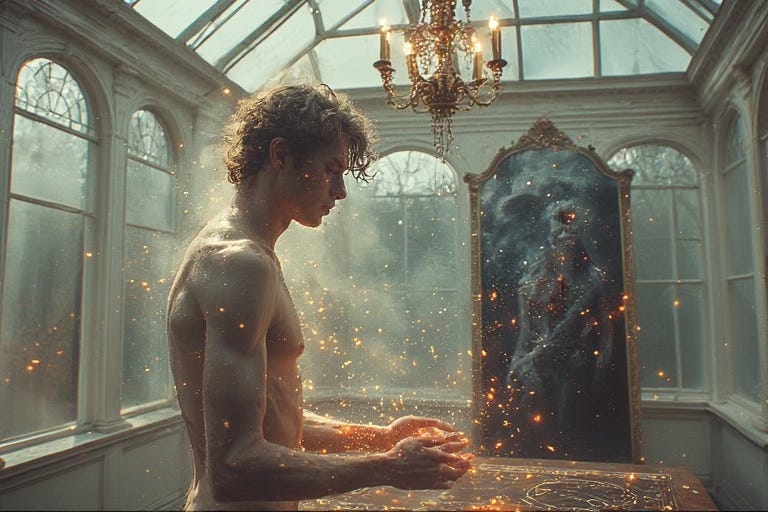
The Integration of the “Other”
Finally, the Mirror Work leads to the integration of the “Other” in the outer world. The Alchemist notices this first in his own gaze—how his eyes linger differently in crowded rooms. Where once they hunted for the square-jawed titan with biceps straining against leather, or the tattooed rebel with cigarette-scarred fingers, they now seek something more luminous. He finds himself drawn to the man reading Rilke in the corner, whose hands move with deliberate grace, whose laughter reveals crow’s feet earned through actual joy rather than performed intensity. Their first conversation feels like stepping into a clearing after years of hacking through underbrush—expansive, breathable, without the suffocating urgency of Nigredo entanglements where texts went unanswered for calculated hours and jealousy was mistaken for passion. In this Albedo connection, silence between them feels like silver thread being spun rather than a chasm widening. Their bodies orbit each other with the elegant mathematics of celestial mechanics—approaching, retreating, circling—two complete galaxies engaged in a cosmic dance rather than desperate black holes locked in mutual consumption.
This is the gift of the Mirror, polished to a gleam that reflects both the visible and the unseen. By witnessing our own face in its mercurial depths—noting each line etched by laughter, each furrow carved by grief—we finally acquire the crystalline vision to truly see others. We stop projecting our private cinema of fears and fantasies onto their luminous presence. Instead, we behold the man before us in his complete alchemical nature: the gold of his higher self shimmering beneath his skin like ore veins in moonlight, and the shadow that pools beneath his feet on even the brightest days. We love him for both elements, this perfect amalgam of light and dark, because we have learned to cherish our own duality in the silvered truth of the glass.
Caput III: The Whitening of the Shadow
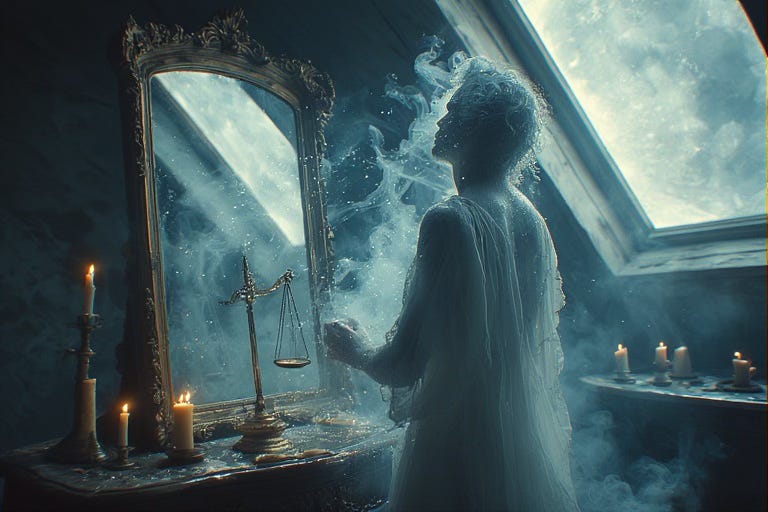
Psychological Albedo: From Immersion to Reflection
The transition from Nigredo to Albedo marks a fundamental shift in the mechanics of the psyche—like stepping from a smoke-filled basement into a room of polished silver mirrors. In the soot-stained heat of Nigredo, shadow work was an act of Immersion, where we descended into the sewer of the soul, ankle-deep in viscous black tar that sucked at our heels with each step. We waded through the muck of our own repressed history—the shame that burned like acid against bare skin, the rage that pulsed behind our eyes with each heartbeat, the perverse fantasies that whispered to us in familiar voices, the internalized hatred that coated our lungs like coal dust. The instruction carved into the obsidian door was clear: Do not look away. We had to feel the full, crushing weight of our own darkness pressing down on our chest like a medieval torture device, compressing our ribs until breathing became an act of defiance, all to realize that this pressure would not kill us. We had to scream, “I am this!” until the throat was raw and tasting of copper, until the words echoed back to us from the dripping stone walls of our deepest self.
But if we remain in immersion forever, we drown in those black waters, lungs filling with the viscous tar of our own making. We become so deeply identified with the wound that it transforms from injury to identity. We metamorphose into the “Professional Victim” with his collection of perfectly polished traumas displayed like trophies, or the “Tortured Artist” who refuses healing because pain is his only reliable muse. We become creatures who cannot survive without our suffering, fingers perpetually returning to the raw edges of our wounds, forever picking at the crimson scab to prove to ourselves and others that we are still gloriously, legitimately bleeding.
As the furnace cools from its scorching heat to a gentle warmth that merely pinks the skin, the Alchemist notices the first silvery rays of Albedo dawn breaking through the laboratory’s eastern window, casting pearl-white reflections across the mercury pools on the floor. The Alchemist’s trembling hands unfold a parchment bearing a new instruction written in ink that shifts from obsidian to quicksilver: “Differentiation.” No longer must he writhe as one with his shadow-self; instead, he stands apart, observing the darkness that once consumed him. The Albedo of the Shadow requires not another descent into that sulfurous pit where monsters lurk, but rather the patient extraction of each creature—using silver tongs that neither burn nor tarnish—lifting them one by one into the clean, crystalline light of the laboratory. There, on a table of polished stainless steel that gleams like a frozen lake, he arranges these shadow-beings. With soft cloths soaked in rosewater, he tenderly washes away the caked mud from their iridescent scales, revealing patterns never before seen. Leaning close, his breath fogging the metal surface, he whispers to each specimen, “What are you, really? And how do you work?”
We no longer say, “I am a broken, shameful thing.” Instead, we stand at the laboratory table, silver scalpel in hand, and dissect the specimen before us with the precision of an anatomist. “Here lies a complex,” we note, sketching its contours in our leather-bound journal, “with tendrils that reach toward the amygdala, triggering fight-or-flight when touched.” This methodical examination marks the birth of the Observing Ego—the “Silver Witness” who sits in the high-backed chair of consciousness, hands folded calmly in lap, eyes clear as mountain lakes after rain. This witness doesn’t wear the sterile white coat of clinical detachment; rather, it drapes itself in quicksilver robes that catch and reflect every emotional nuance while remaining unmeltable, unburnable—cool to the touch not from absence of feeling, but from the perfect equilibrium of understanding.

The Laundering of the Complexes
In Jungian psychology, a “Complex” is a knot of psychic energy formed around a core of trauma or intense emotion—imagine a pearl, but instead of iridescent nacre, layers of reactive emotion have calcified around a grain of unbearable pain. It has its own gravitational field, dense as a neutron star, warping the fabric of your consciousness. It pulls your thoughts and behaviors into its orbit like cosmic debris. In Nigredo, these complexes manifested as writhing, obsidian demons with sulfurous breath and talons that hooked into your solar plexus. They possessed us completely, puppeteering our bodies from within. We would find ourselves acting out—screaming at a partner until our throats were raw and veins bulged at our temples, binging on destructive behaviors with the desperate hunger of the starving, collapsing into self-loathing so complete we could taste its metallic bitterness coating our tongues—and feel powerless to stop it, as if watching ourselves through thick glass while something else controlled our limbs.
In Albedo, we perform the Laundering of the Complexes. Picture yourself standing before an ancient stone basin filled with water so clear it appears silver in the moonlight. You immerse each complex—these tangled knots of emotion and memory—into the luminous liquid, watching as decades of accumulated grime dissolve away. Your hands work the fabric of these psychic constructs like a medieval washerman, fingers rubbing against the coarse weave, knuckles whitening with effort. The water clouds, then clarifies. To “launder” a complex means to scrub away the encrusted dirt of the traumatic context in which it was born, revealing the gleaming, original function it was trying to serve. Every demon in the Queer psyche—with its scales and talons and sulfurous breath—began its existence as a radiant angel of survival, wings folded protectively around the vulnerable self. It became twisted and monstrous only because it had to operate in the suffocating dark of shame and secrecy for so long.
Let us place the two most common demons of the Queer Male psyche onto the silver table: The Internalized Oppressor, with his perfect posture and steel-rimmed glasses, his voice like a headmaster’s ruler across knuckles; and the Hyper-Sexual Ghost, translucent and hungry-eyed, his skin feverish to the touch, trailing the scent of nightclub bathrooms and borrowed cologne.

I. The Internalized Oppressor (The Inner Homophobe)
The Nigredo Appearance: He is the Tormentor. He is the voice in the back of the skull that sounds suspiciously like a father, a priest, or a playground bully—precise in its articulation, each syllable carved like a knife between the ribs. His whispers come at 3 AM when you lie sweating in twisted sheets, or in the fluorescent bathroom at work when you catch your reflection: “Look at your soft hands, your unmanly gait. You are disgusting. You are a faggot. You will die alone in a sterile apartment with no photographs on the walls. No one loves the real you. You are a fraud wearing borrowed skin.” In Nigredo, we fought him with white knuckles and clenched teeth. We shouted back until our throats were raw. Or we collapsed under his blows, believing every poisoned word as it crystallized in our blood. We tried to kill him with alcohol, with anonymous sex, with meditation apps abandoned after three days, but he is immortal because he is part of us—sewn into our marrow before we had language to name him.
The Albedo Operation (The Washing): We place this figure on a marble altar bathed in White Light so intense it seems to vibrate the air around us. With trembling fingers, we peel away each venomous insult like removing layers of tarnish from ancient silver. We carefully extract the sneering tone of the bully, separating it like oil from water, watching it dissipate into wisps of gray smoke. What remains is a pulsing core of raw, unformed energy—neither good nor evil—just pure intention glowing with an opalescent sheen. Leaning close enough to feel its warmth against our face, we whisper the Alchemical Question that unlocks its secret purpose: “What was your original job, before the world twisted you?”
We discover that this figure was not born to destroy us. He was born to save us. He crystallized in our psyche when we were five, or seven, or ten years old—a translucent sentinel with eyes like polished hematite, scanning the horizon of our childhood for storm clouds. He was the part of the child-psyche that developed hypersensitive antennae, quivering at the slightest shift in atmospheric pressure. He memorized the unwritten rulebook of the homophobic world with the precision of a medieval scribe. He learned: “If you walk with a sway that has even a hint of fluidity, Dad’s jaw tightens like a vise and his knuckles whiten around his coffee mug. If you let your gaze linger on that boy’s forearms for even two heartbeats too long, the playground becomes a gladiatorial arena. If you speak with a voice that rises and falls like gentle waves rather than breaking like thunder, they circle you like jackals scenting weakness.” So, he took on the job of policing us with military precision. He whispered through clenched teeth, “Don’t do that! You’re being a fag!” not because he hated us, but because he could already feel the phantom sting of the coming blow. He was the Guardian of Safety, patrolling the borders of our expression with the vigilance of a wartime sentry. He preemptively punished us with surgical strikes so the world wouldn’t have to deploy its nuclear arsenal.
The Transmutation: When washed of the “dirt” of hatred, the Internalized Oppressor emerges transformed—his once rigid military posture now carries the dignified bearing of a sentinel rather than the stiff-backed tension of a drill sergeant. His steel-rimmed glasses no longer flash with cold judgment but gleam with the clarity of true discernment. The Albedo Alchemist approaches him in the silver-white chamber, their eyes meeting in mutual recognition. “I see you,” he whispers, voice resonating against the marble walls. “You are the Watchman with the vigilant eyes who stood guard while I slept. You kept me alive in the war zone of my childhood, cataloging every potential threat like a cartographer mapping minefields. Thank you for your service.” Then, placing both hands on the figure’s shoulders, feeling the cool solidity beneath his fingers, he delivers the Edict of Release: “But the war is over. The playground bullies have grown old. The father’s disapproving gaze has lost its power. I am a grown man with a voice that can defend itself. You are relieved of your duty as Jailer.” The figure’s face softens, the deep furrows between his brows beginning to smooth. “I reassign you as Sentry—not of my soul, but of my boundaries.” The complex is not destroyed but repurposed, like a sword melted down and reforged into a shield. The energy that once scrutinized the self for flaws—measuring the angle of wrists, monitoring the pitch of laughter—now turns outward like a lighthouse beam, scanning the horizon for genuine threats. The “Inner Homophobe” dissolves, his essence reconstituting as the “Street-Smart Protector” who can sense danger in a sideways glance from a stranger or the subtle shift in a crowd’s energy, but no longer turns his razor-sharp attention inward to slice at the soul.
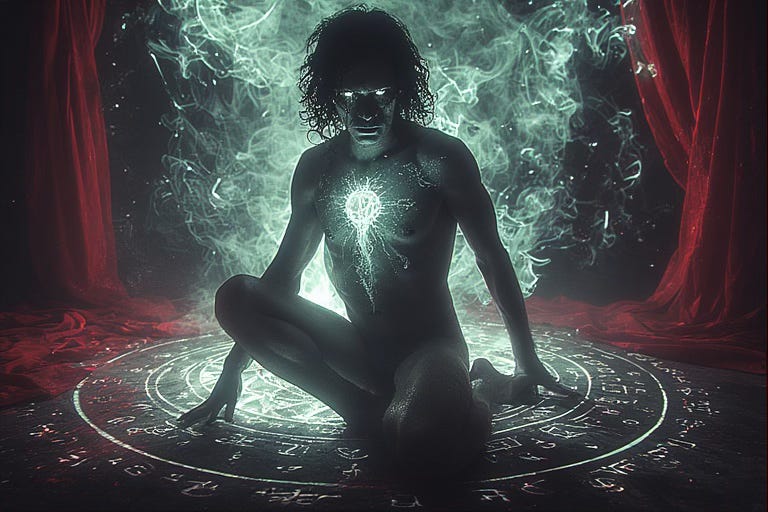
II. The Hyper-Sexual Ghost (The Hungry Hunter)
The Nigredo Appearance: He manifests as the night wanderer, the digital hunter, his face illuminated by the spectral blue glow of the phone screen, casting hollows beneath his cheekbones. His fingers tap restlessly at 3 AM, the soft clicking of nails against glass like rain on a window, downloading apps deleted just days before—Grindr, Scruff, Sniffies—their logos pulsing with neon promise. His footsteps echo through rain-soaked parks where puddles reflect fractured moonlight and anonymous encounters bloom in the darkness between cypress trees and concrete restrooms. He courts danger with a reckless abandon—the knife-edge thrill of a stranger’s apartment, the chemical burn of substances offered by hands he’ll never see again—that leaves the daylight self trembling. During the Nigredo phase, his presence generates a crushing weight of disgrace that sits on the sternum like a gargoyle. The sensation of boundaries dissolving, of contamination spreading through the psyche like ink in water. After each encounter comes the ritual purification: delete the apps with shaking thumbs, swear off all contact while showering under scalding water, make promises to the mirror with bloodshot eyes. Then inevitably, the cycle regenerates with the setting sun.
The Albedo Operation (The Washing): We bring the Hunter into the light, into a chamber of alabaster walls that seem to breathe with a gentle luminosity. We seat him on a chair of silver filigree that catches the light in its spirals. We do not judge him; instead, we observe the way his eyes dart like nervous birds, how his fingers tap against his thigh in a rhythm of unspoken need. We interview him with voices soft as temple bells. We ask: “What are you actually looking for in those dark rooms with their musk of sweat and desperation?” If he answers “Sex,” his voice cracking on the single syllable, we lean closer, our breath mingling with his: “What does the sex give you—that moment when skin meets skin and the world narrows to a pinpoint of sensation?” If he answers “Release,” we press further, watching the pulse at his throat quicken: “Release from what? From which prison are you seeking parole?” We keep drilling down through layers of pretense and protection, through sediment of shame and strategy, until we hit the gleaming core that pulses like a star beneath the mud.
We find that beneath the frantic, compulsive behavior lies a Seeker of Connection or a Priest of Eros. The Hunter moves through darkened rooms like a pilgrim searching for a holy relic, fingers tracing the contours of strangers’ bodies as if reading sacred texts in braille. He is not looking for mere friction; he is looking for the Divine Spark—that electric blue flash when skin meets skin and two souls momentarily recognize each other across the void. He is looking for the precise instant where the loneliness dissolves like salt in hot water, leaving only a residual taste of what was once unbearable. He is looking for touch—fingertips pressed into shoulder blades, palms cupping jawlines—in a world that starved him of it, leaving him with skin hunger so acute it feels like the surface of his body is covered in microscopic mouths, all gasping for air. He is looking for Validation—the proof that he exists and is desirable—reflected in the dilated pupils of a stranger’s gaze. The behavior (the anonymous, risky, compulsive sex) was just the muddy expression of a pure need, like drinking from puddles when what you truly crave is spring water. It was the only language his starving spirit knew how to speak, the only table at which he believed he could feast.
The Transmutation: The Albedo Alchemist transforms rather than denies the desire, knowing that mere repression would only force it back into Nigredo’s darkness where it would fester like a wound beneath pristine bandages. Kneeling before the Hunter on the cool alabaster floor, moonlight streaming through high windows to create pools of silver at their feet, he whispers: “Your hunger is sacred. You seek divine communion but search for it among refuse and wreckage, like a man drinking salt water to quench his thirst.” The Hunter’s eyes, once darting and feverish, grow still as mountain lakes. Thus begins the delicate alchemy of Sublimation—extracting precious metal from raw ore, separating gold from lead with patient hands that know the difference between dross and treasure. He pursues authentic Connection that feels like roots growing between two separate trees, Intimacy that creates a shared atmosphere as tangible as morning fog, and Ecstasy that rises like cathedral spires toward heaven rather than crashing like lightning. All this without consuming the toxic sediment of Shame that once sat heavy as mercury in his belly, Danger that made his skin prickle with false electricity, and Dissociation that frosted his vision like breath on winter glass—elements that once seemed inseparable from pleasure. When he enters the shadowed room of casual encounter, he carries inner luminescence that makes his skin glow like alabaster lit from within. His gaze meets his partner’s directly, clear as spring water rather than clouded with agenda. The act of joining bodies becomes ceremonial, deliberate—each touch a brushstroke on living canvas, each breath a note in a composition that requires no audience. In this way, he nourishes the Priest of authentic desire, adorned in vestments of conscious choice, rather than the Ghost of compulsion who haunted midnight streets with hollow eyes.
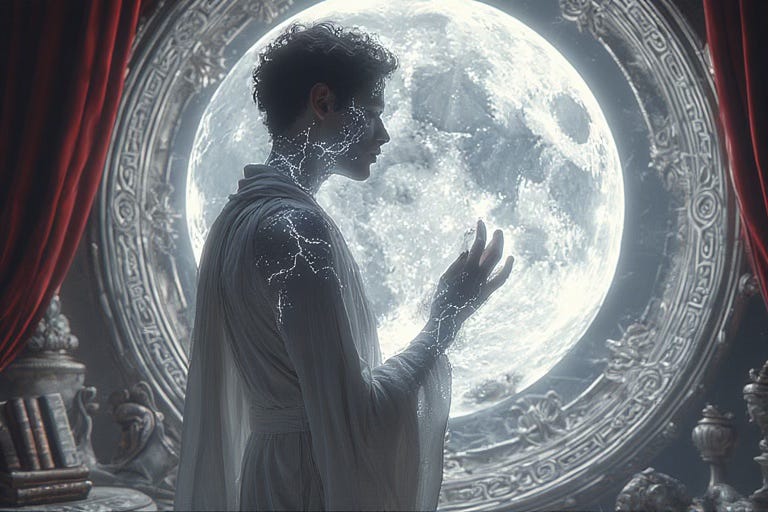
The Rite of Withdrawal: The Incubation of the Soul
How do we create the space for this subtle work? The constant ping of notifications, the relentless scroll of social media feeds, the thrum of traffic outside your window, the expectation of immediate responses to texts—all of it drowns out the whisper-quiet voice of your deepest self. The Albedo requires the Rite of Withdrawal: a deliberate stepping away from the cacophony, like closing heavy velvet curtains against harsh sunlight, creating a chamber of silver silence where the soul can finally hear itself breathe.
In the Queer community, there exists a relentless pressure to be “Always On”—to maintain visibility like a neon sign that never dims, to remain available like a 24-hour diner with its windows perpetually lit, to attend every party as if absence might erase existence itself. The digital notifications ping like heartbeats; miss too many, and the social body assumes cardiac arrest. The Albedo Alchemist, with his alabaster resolve, shatters this unwritten commandment. He draws the heavy velvet curtains of White Silence across his life’s stage. He peels away from the “Scene” like skin healing from a burn. He deletes the apps, his thumb hovering over each icon before pressing down, watching them wiggle and disappear not out of shame, but out of hunger for the sound of his own breathing.. When invitations arrive—their text bubbles urgent and insistent—he crafts gentle refusals. His Friday nights unfold in the cathedral-quiet of his apartment, where bookshelves become altars and journal pages transform into mirrors. This is Incubation: the sacred chrysalis-time where dissolution precedes reformation.
Think of the caterpillar in its silk-spun sanctuary, suspended from an oak branch, motionless in the winter air. To the casual observer, it appears lifeless—a desiccated husk swaying in the breeze. But within that translucent chamber, cellular alchemy unfolds. The caterpillar’s body dissolves into a primordial soup of imaginal cells, each containing the encrypted blueprint of wings and antennae, of compound eyes that will one day drink in ultraviolet light. The Queer Man in Incubation retreats similarly into his alabaster chamber, gathering the scattered fragments of his luminescence—those silver shards of selfhood he once cast like coins into the wishing wells of others’ approval. Every notification he once craved—the crimson heart beneath a carefully curated photograph, the midnight text message with its promise of fleeting connection, the coveted invitation to exclusive gatherings—was a hemorrhage of his auric essence, golden droplets seeping from invisible wounds. In the sacred Withdrawal, he cauterizes these leaking vessels. He cups his palms to collect his own radiance, feeling its weight like sun-warmed honey against his skin. He learns to generate heat from within, like a pearl forming around the irritant of his own loneliness. Eventually, he discovers the paradoxical fullness of emptiness—sitting cross-legged on bare hardwood floors in an unadorned room, feeling the universe expand within his chest cavity, stars blooming behind his closed eyelids.
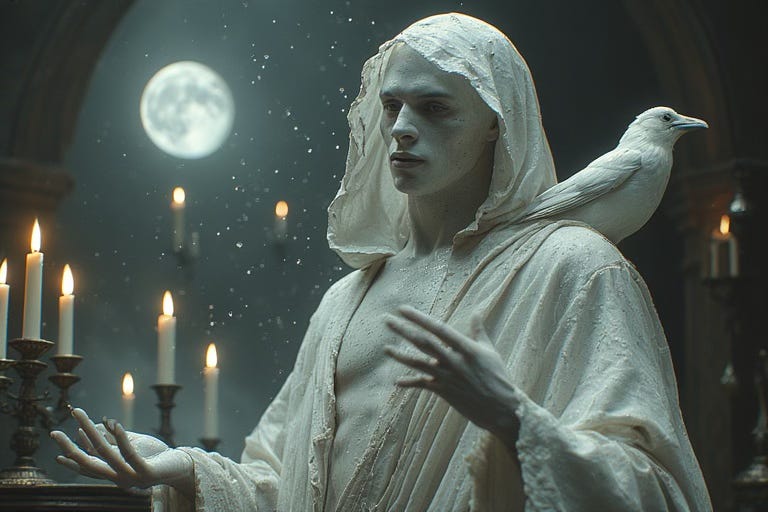
The Ethics of the White Stone: The Shadow of Virtue
Finally, Albedo Shadow Work requires a new ethical vigilance. As the alchemist’s inner laboratory gleams with purified vessels and alabaster surfaces, a subtle danger emerges from the corners where light casts the sharpest shadows. The shadow of Nigredo was “The Monster”—that snarling, wounded creature who lashed out from pain and wore shame like a second skin. The shadow of Albedo, more insidious in its pristine appearance, is “The Saint”—who stands bathed in moonlight, robes impossibly white, fingers steepled in judgment of those still crawling through the mud.
When we wash ourselves clean, we risk developing the Shadow of Virtue—that alabaster-white narcissism that gleams like polished marble under moonlight. The Queer Man who has done “The Work” sits cross-legged on his imported meditation cushion, aromatherapy diffuser releasing wisps of sandalwood into his minimalist apartment, scrolling through Instagram with a smirk playing at the corners of his lips. He watches videos of sweaty bodies pressed together in basement clubs and thinks, “How primitive.” He listens to his friend’s dating woes over oat milk lattes, nodding with performative compassion while mentally diagnosing “attachment trauma” and “unprocessed father wounds.” His vocabulary becomes a silver scalpel—”projection,” “shadow work,” “integration”—dissecting others’ lives with clinical precision. His healing journey transforms into a crystal staircase that elevates him above the unwashed masses. “I have transcended,” his posture declares. “I am Albedo, purified and gleaming. You remain Nigredo, still covered in soot.”
This is the most dangerous trap of the White phase—a crystalline labyrinth where walls of polished virtue reflect only your own satisfied smile. Here, the Internalized Oppressor returns, no longer wearing tattered clothes of self-hatred, but flowing silver-white robes of the Guru, adorned with beads of spiritual jargon. The Alchemist must daily wash his own righteousness in the basin of humility, scrubbing away the pearlescent film of superiority that forms overnight like frost on a window. He must hold the White Stone in trembling palms, feeling its cool weight not as a medal pinned to his chest, but as a lantern to be carried into shadowed corners. When he passes the threshold of the dark room where sweaty bodies press together in ancient rhythms, he must recognize his brother there—the man he was yesterday, with pulse quickening and pupils dilated by desire, the man he could be tomorrow if his alabaster resolve should crack. True Albedo does not stand at the doorway with arms crossed and eyebrow arched; it moves through the darkness like moonlight through forest branches, touching each face with silver recognition. When the Albedo Alchemist enters a crowded subway car or a hushed therapy circle, others should not feel the chill of judgment crawling up their spines, but rather the gentle warmth of being truly seen, as if bathed in the soft, diffuse glow of the moon rather than caught in the harsh, interrogating beam of a searchlight that exposes every flaw.
Caput IV: Ablutio and the Sacred Fluids of Light
The Transmutation of Body Fluids
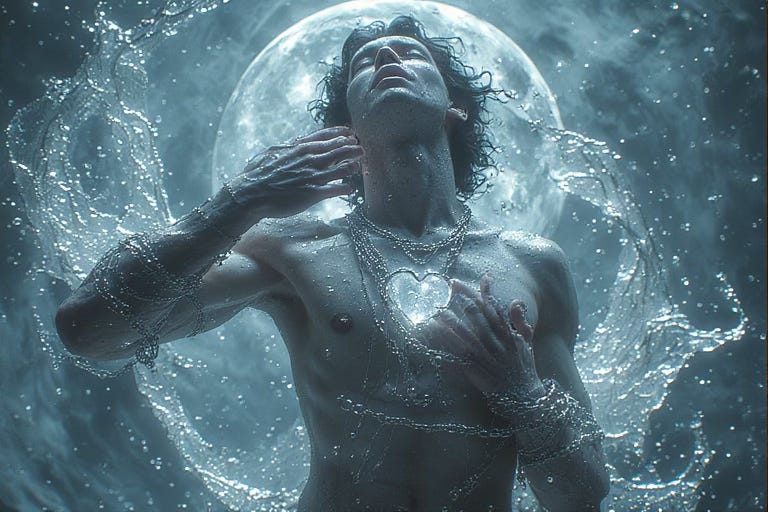
In the Nigredo, the body’s fluids hung thick and viscous like December fog. They were the primordial waters of the swamp—murky brown-green pools teeming with chaotic life, releasing vapors that smelled of iron filings left in rain, of musk deer glands, of copper pennies dissolved in saliva. Blood ran dark and sluggish, carrying microscopic barbed hooks of fear (the plague that hollowed men from within, that turned lovers into obituaries). Sweat beaded on furrowed brows and pooled in the small of backs, each droplet weighted with the salt of fourteen-hour shifts and the acrid tang of shame that burned the nostrils. Semen clung like pine sap to fingers, the sticky amber resin of desperate attachment and blind biological compulsion that dried into crusted evidence of momentary surrender. In Albedo, the alchemical operation of Sublimatio (Sublimation) transforms these dense matters into ethereal essence. The heavy waters are distilled in glass vessels curved like question marks. They rise as gossamer steam, abandoning their sediment of trauma and toxins, and condense on cool surfaces as “Dew” or “White Rain”—droplets clear as vodka, refracting moonlight into miniature rainbows. The fluids of the Queer Male body remain chemically identical—blood still carries iron and oxygen, semen still contains its spiraling tadpoles of potential—but their energetic signature is transmuted from lead to silver. They shimmer now with opalescent purpose. They are no longer waste products or vectors of disease to be feared; they become the Sacred Fluids of Light, luminous as mercury rolling in a porcelain dish. They become the sacraments of the Ecclesia Carnis (The Church of the Flesh), holy as the water that beads on baptismal foreheads.

I. The Seminal Light: The Gluten of the Eagle
In the Nigredo, the body’s fluids hung thick and viscous like December fog. They were the primordial waters of the swamp—murky brown-green pools teeming with chaotic life, releasing vapors that smelled of iron filings left in rain, of musk deer glands, of copper pennies dissolved in saliva. Blood ran dark and sluggish, carrying microscopic barbed hooks of fear (the plague that hollowed men from within, that turned lovers into obituaries). Sweat beaded on furrowed brows and pooled in the small of backs, each droplet weighted with the salt of fourteen-hour shifts and the acrid tang of shame that burned the nostrils. Semen clung like pine sap to fingers, the sticky amber resin of desperate attachment and blind biological compulsion that dried into crusted evidence of momentary surrender. In Albedo, the alchemical operation of Sublimatio (Sublimation) transforms these dense matters into ethereal essence. The heavy waters are distilled in glass vessels curved like question marks. They rise as gossamer steam, abandoning their sediment of trauma and toxins, and condense on cool surfaces as “Dew” or “White Rain”—droplets clear as vodka, refracting moonlight into miniature rainbows. The fluids of the Queer Male body remain chemically identical—blood still carries iron and oxygen, semen still contains its spiraling tadpoles of potential—but their energetic signature is transmuted from lead to silver. They shimmer now with opalescent purpose. They are no longer waste products or vectors of disease to be feared; they become the Sacred Fluids of Light, luminous as mercury rolling in a porcelain dish. They become the sacraments of the Ecclesia Carnis (The Church of the Flesh), holy as the water that beads on baptismal foreheads.
In the Albedo stage, the Queer Male reclaims his seed from the narratives of “waste” and “death.” The pearlescent fluid, once denounced from pulpits as an abomination when spilled without procreative intent, shimmers with new purpose under moonlight. Historically, religious texts condemned Onanism with vivid imagery of divine wrath—fire raining from heaven, wombs sealed shut, generations unborn crying out in the void—all because this essence “produced nothing.” The Queer man was handed pamphlets depicting his sexuality as a barren field where nothing grew but thorns of disease and shame. The Albedo Alchemist, his laboratory illuminated by silver candlelight reflecting off polished mirrors, flips this script. He catches his release in a chalice of understanding rather than a tissue of disgust. He realizes that because his seed is not destined for biological reproduction, it transforms into something more ethereal—droplets of liquid light that nourish his inner garden. It is not wasted; it is dedicated, like mercury carefully collected and preserved for the Great Work.
The Practice of the White Tantra (Sublimation): The Nigredo sexuality manifested as “Desperate Release”—fingers fumbling with zippers in darkened bathroom stalls, breath ragged and uneven, the frantic pumping of a fist seeking only the momentary oblivion of emptiness. The Albedo sexuality transforms into the discipline of Retention and Circulation. This is the practice Coitus Reservatus or “Edging” raised to a high art. The Alchemist lies naked on cool white sheets, moonlight dappling his skin through venetian blinds. His fingertips trace slow spirals across his chest, down his abdomen, lingering at each chakra point until the skin beneath them flushes pink. When he finally touches himself, it is with reverent precision. As the pleasure builds to that knife-edge precipice, he inhales deeply through his nostrils, drawing the electric sensation upward. The energy—visualized as an iridescent white eagle with wings of pearl and diamond—ascends his spine vertebra by vertebra, its talons gripping each nerve ganglion, transmuting red molten heat into crystalline white light. This luminescence floods the cranial cavity, bathing the soft gray folds of the brain in phosphorescent nectar that tastes like starlight on the back of the tongue. The pineal gland—that pine-cone shaped mystery at the center of the skull—drinks this radiance like a desert flower in first rain, unfurling hidden petals. When release finally arrives, it is not the frantic spasm of Nigredo, but a slow-motion supernova, the body arching in perfect geometry, the fluid emerging not as waste but as opalescent mercury, each droplet containing a universe in miniature.

II. The Tears of the Moon (Lachrymae Philosophorum)
In the Nigredo, we wept tears of salt and blood—thick, viscous droplets that burned tracks down our cheeks and tasted of copper pennies on our tongues. We wept for our lost childhoods spent hiding behind carefully constructed masks, for our dead friends whose names filled memorial quilts stretching across the National Mall, for the casual cruelty of a world that turned away while we disappeared. Those scorching tears were necessary; they were the breaking of a dam built from decades of compressed silence. But there is another kind of weeping. In Albedo, we encounter the Lachrymae Philosophorum—the Tears of the Philosophers—crystalline rivulets that catch moonlight like liquid silver, transforming each eyelash into a prism. These tears do not stem from grief’s jagged wound. They flow from the expansive chamber where Awe resides, where breath catches and the body trembles with recognition of beauty too vast to contain.
Imagine standing in a club at 2 AM, your body pressed among hundreds of others, sweat-slicked skin gleaming under azure strobes. The bass thrums through your sternum in perfect synchronicity with your heartbeat—thump-thump, thump-thump—until the distinction between music and pulse dissolves. Then, as the DJ layers in that vocal sample you’ve waited for all night, something cracks open inside your chest. Your throat constricts. Moisture wells along your lower lashes, trembling there before spilling down your cheeks in silver rivulets that taste of salt and revelation. Or picture yourself at dawn, propped on one elbow, watching your lover’s eyelids flutter in REM sleep, his chest rising and falling beneath a sheet twisted around his waist. Moonlight gilds his profile—the aristocratic nose, the stubbled jaw, the lips slightly parted. Something about the vulnerability of his existence—the miracle that of all possible worlds, you inhabit the one where he breathes beside you—triggers an upwelling of emotion so pure it manifests as crystalline droplets that slide silently onto your pillow. These are the Albedo Tears, the “White Rain” that transforms perception from opacity to transparency. Ancient alchemical texts describe how the philosopher’s stone reveals itself only to those whose vision has been clarified by weeping—not the hot, angry tears of frustration nor the brackish waters of despair, but the cool, lunar tears of wonder. For the Queer Male, conditioned by playground taunts and locker room threats—”Boys don’t cry” hissed through clenched teeth, “Don’t be such a girl” accompanied by a shove against metal lockers—this reclamation of tears becomes revolutionary. In Albedo, weeping becomes a technology of perception, each droplet a lens that magnifies truth. These tears lubricate the soul’s rusty hinges, dissolve the calcified deposits around a heart long defended. When we surrender to these silver tears, we aren’t collapsing inward but expanding outward, not breaking down but breaking through layers of armored numbness. We are the caretakers washing centuries of soot from stained glass windows, so that colored light can once again illuminate the temple’s interior.
III. The Lunar Bath: The Ritual of Ablutio
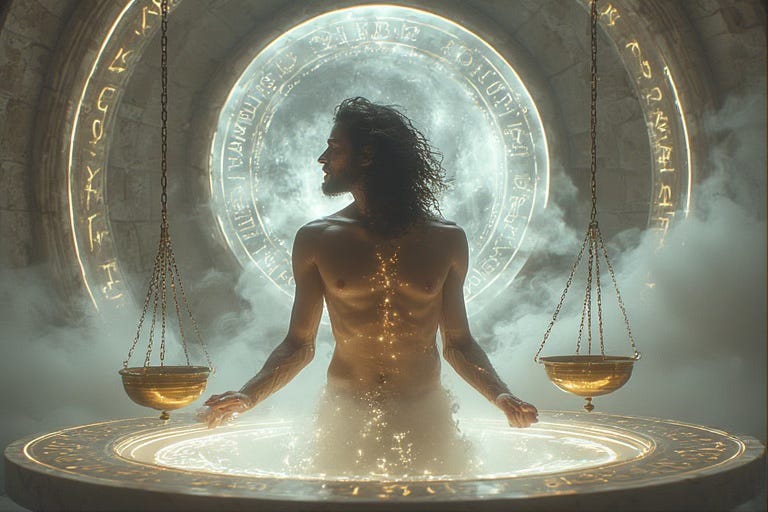
The central ritual of this chapter is the Alchemical Bath, where water—element of the Albedo—transforms from mere liquid to sacred solvent of the soul. In ordinary life, the Queer Man’s relationship with bathing often reduces to utility: a perfunctory five-minute shower before rushing to work, water scalding hot to scour away sleep; or perhaps a hasty pre-hookup rinse, movements economical and focused solely on hygiene’s most essential zones. The Albedo Alchemist, however, transforms his porcelain tub and tiled walls into the Thermae—the sacred bathhouse where Roman senators once communed with Mercury’s mysteries. Steam rises in lazy coils like incense smoke, condensing on cool surfaces into droplets that catch light like scattered moonstones.
The Construction of the Ritual: The bath is drawn not with hot water (which belongs to the Red/Solar stage) but with tepid water that kisses the skin without shocking it—precisely the temperature of tears or amniotic fluid (Lunar/Silver). Sea salt crystals are added, not the harsh table variety but delicate flakes harvested from the Mediterranean, each grain a miniature prism catching light as it dissolves. This salt is the “Body” in alchemy—the crystal of earth that has been purified by fire and water, then transformed through dissolution. It grounds the ritual, anchoring ethereal energy into physical form. Whole milk may be added (precisely one silver cup), poured in a slow clockwise spiral until it blooms into cloud-like formations beneath the surface. The milk—pearlescent and opaque—is the primal nutrient, the whiteness of innocence, the food of the infant. As it diffuses through the water, it symbolizes the “rebirth” of the self, the dissolution of rigid boundaries between what was and what will be.
Essential Oils: Camphor, Eucalyptus, White Rose, or Jasmine. Cooling, opening scents.
The Immersion: The Alchemist slips into the water, his bare flesh meeting the cool liquid with a soft hiss of recognition. Every inch of his naked body—from the vulnerable hollow of his throat to the tender arches of his feet—is stripped of the invisible garments he wears daily: the stiff collar of professional competence, the tight belt of masculine performance, the suffocating undergarments of social acceptability. As he extends his limbs and allows his weight to surrender, his body rises to the surface like driftwood. The water laps at his earlobes, creating a rhythmic susurration that drowns out the world’s cacophony. He performs the Dissolution with deliberate breaths—seven counts in, eleven counts out—feeling the boundary between his dermis and the water blur and dissolve. His skin, no longer a barrier but a permeable membrane, tingles with microscopic openings. Through these countless doorways, the mineralized water seeps inward while the accumulated “Black Ash” of the Nigredo seeps outward—memories of childhood taunts (”sissy,” “fairy,” “girl”) dissolving like ink in water; the phantom sensation of unwanted hands gripping his shoulders in dark corners evaporating like camphor; the sticky residue of shame that has clung to his pleasure centers for decades now floating away in tendrils of sooty vapor. The salt water—each crystal a tiny alchemical laboratory—neutralizes these toxins on contact, transforming acid to base, pain to neutrality. His consciousness shifts. He is no longer a thirty-eight-year-old man with student loans and crow’s feet but a floating consciousness suspended in the primordial sea, umbilical cord still pulsing with silver light. In this timeless amniotic suspension, the binary constructs that have caged him dissolve. The labels “Gay” and “Straight” drift away like discarded husks, revealing themselves as mere taxonomies invented by frightened minds. Here, floating in the silver-white waters, there is only the pure current of Life—undifferentiated, unbroken, and perfect in its simplicity.
The Sealing: When he emerges, water cascades from his shoulders in silver rivulets, each droplet catching the soft light. He does not rub the skin red with a rough towel, but instead pats himself dry with a cloth woven from Egyptian cotton, its fibers as white as moonlight on snow. From an alabaster jar, he scoops a fingertip of the Unguent—a pearlescent balm scented with white sage and frankincense. This is the “Silvering.” With reverent precision, he traces a glistening path across his sternum, feeling the thrum of his heartbeat beneath his fingertips. He anoints the hollow of his throat where words form, then moves lower, palms gliding over the tender skin of his genitals. Each touch is deliberate, a sacred reclamation. “This body,” he whispers, voice barely disturbing the steam-thick air, “is not a public commodity. It is not a target for violence. It is not a vessel of disease. It is the Temple of the White Stone.” The balm absorbs completely, leaving no residue, only a subtle luminescence like moonlight on water. He feels the microscopic pores of his skin contract, sealing the energy within. He is now “Water-Tight,” his aura an impermeable silver membrane that allows him to walk into the world without leaking his power and without absorbing the poison of others.

IV. The Clear Urine: The Gold in the Water
Even the humblest fluids are reconsidered with reverent attention. In Nigredo, we spoke of the golden stream as a release of toxins—dark amber and pungent. In Albedo, we notice the crystalline clarity, pale as moonlight filtering through spring water. Paracelsus, the great alchemist with his silver-flecked beard and eyes sharp as scalpels, diagnosed the spiritual state of his patients by examining their urine in delicate glass flasks held up to candlelight. He looked for the “Gold in the Water”—those suspended particles that caught the light like stars in a night sky. For the Queer Alchemist, hydration becomes a spiritual discipline, each sip of cool water passing through lips with intention, trickling down the throat to nourish cells that sparkle with renewed purpose. To keep the inner waters clear—transparent as tears—is to keep the channel open between body and spirit. The act of urination becomes a mini-Ablutio, the porcelain bowl a sacred chalice. As the water leaves the body in a gentle arc, the Alchemist visualizes the release of psychic debris—old hurts dissolving, others’ projections washing away. “I release what is not mine,” he whispers, watching the water spiral away. It is a constant, daily practice of letting go, performed in the most intimate of temples. The Alchemist does not hoard emotions or grievances; he processes and releases them with each cleansing stream. He is a river—fluid, moving, ever-renewing—not a swamp of stagnant waters and buried things.

V. The Sweat of Purification
Finally, there is the White Sweat—droplets like liquid pearls that bead across the forehead and trace crystalline paths down temples and spine. This is not the acrid, cold sweat that pools in the armpits of the anxious man, nor the heavy, salt-crusted musk of the laborer’s back. This is the purifying dew of the Cedar Sauna, where pine-scented air shimmers visibly in waves of heat. The Sweat Lodge or the Sauna has always been a sacred vessel of male bonding—wooden womb where warriors and elders sat shoulder to naked shoulder, their breath mingling in clouds of vapor. In the Queer community, the sauna’s dim corners and slick benches are often transformed into theaters of desire—eyes meeting across steam-veiled space, hands brushing thighs in silent proposition. But in the Albedo mode, the Alchemist reclaims this space. He sits motionless on the highest bench where heat presses down like a physical weight, lungs expanding against the resistance of superheated air. Rivulets of sweat cascade from every pore—each droplet carrying microscopic particles of accumulated toxins, emotional residue, and societal contamination to the surface. The sweat that drips from his chin onto the cedar planks below is the physical manifestation of the Separatio—clear evidence of inner alchemy made visible. He watches his own skin flush pink then red, the “Old Man” literally being boiled away, leaving new flesh beneath. He sits in meditative silence among other men—their bodies in various states of beauty, decay, strength, and vulnerability—all rendered equal by heat’s democracy. The banker’s manicured body releases the same clear essence as the drag queen’s glitter-stained skin; the muscle god’s sculpted abdomen glistens identically to the elder’s papery chest. Through the billowing clouds of steam—white as a bride’s veil—all men become equal, their differences dissolved in the purifying mist that reveals our shared, glistening humanity.
Caput V: The Rituals of Whiteness
The Praxis of the Silver Star
We have spoken of the philosophy of Albedo (the theory) and the psychology of Albedo (the shadow work). Now we must speak of the Praxis—the doing. The Alchemist rises at dawn, the silver-blue light filtering through gauzy curtains. He moves with deliberate steps across cool tile floors, each movement precise as a compass needle. His laboratory is his bedroom, where white sheets lie in crisp hospital corners; his bathroom, where crystal bottles of oils catch morning light; his altar, where candle wax has hardened into perfect circles. His instruments are his body—skin now luminous as mother-of-pearl; his breath—no longer ragged but measured in perfect counts; and his will—a polished blade. In the Albedo stage, the chaotic, improvised rituals of the Nigredo (which were often screams for help or desperate acts of survival) are replaced by the Rituals of Order. Where once he threw salt over his shoulder with trembling hands, now he measures it in silver spoons. Where once he wept into bathwater, now he adds seven drops of jasmine oil with an eyedropper. Albedo is the stage of geometry, of precision, of cool light—the light of stars rather than flames. The rituals here are designed to stabilize the volatile psyche, to seal the vessel like mercury in glass, and to anchor the “Silver Light” in the flesh until the body itself seems to glow from within.
The following are the three Great Operations of the Albedo Phase—sacred alchemical practices that transform the Queer Male Alchemist’s psyche from leaden darkness to luminous silver. Each ritual, performed with meticulous attention to detail and reverent intention, creates a crystalline architecture of purification within which the wounded soul may heal and the fragmented self may reunite in pearlescent wholeness.
Operation I: The Rite of the White Table (Mensas Alba)
Purpose: The White Table serves as a physical mirror of the alchemist’s inner landscape—a sacred space where the purified consciousness takes tangible form. Here, the scattered elements of the self crystallize into visible symbols, allowing the ephemeral Terra Alba to root itself in the material world.
The Setup: With reverent hands, the Alchemist sweeps away the remnants of his Nigredo phase—the obsidian skulls that once witnessed his despair, the jagged black crystals that absorbed his rage, the icons of vengeful gods that mirrored his fury, and those small, painful keepsakes he once clutched like lifelines. His altar—whether an ornate table or simple shelf—stands bare, awaiting its transformation.
He drapes the altar with cloth as white as winter moonlight, choosing either linen for its earthiness or silk for its ethereal quality. Upon this pristine canvas, he arranges precisely four objects—no more, no less—each embodying one of the purified elemental forces of the Albedo phase:
Earth: A bowl of sea salt or a piece of white quartz/selenite. (The crystallized body).
Air: A white feather or a stick of high-quality, subtle incense (Sandalwood or Copal). (The clear mind).
Fire: A single white candle in a glass or silver holder. (The cool, focused will).
Water: A silver or glass chalice filled with fresh water. (The purified emotion).
The Ritual: Perform this ritual at dawn—what we call the “Silver Hour”—when the world hangs suspended between night and day. Stand before your White Table with skin still damp from morning ablutions, clothed in white garments or nothing at all. Touch flame to wick and watch the candle’s light bloom. Assume the Pillar posture: feet pressed together, spine elongated toward heaven, arms resting at your sides. Draw breath into the stillness. Envision a perfect sphere of radiance hovering just above your crown—this is Kether, the point where divinity touches humanity. As you inhale, guide this luminescence downward; feel it pour like quicksilver along your vertebrae. Now, with voice clear and unwavering, pronounce the Invocation of the Silver Star:
“I am the Silver Mirror. I reflect the Light, I do not absorb the Darkness.
My bones are the White Earth. My blood is the White Water.
I am the Eye that sees but does not judge.
I am the Hand that heals but does not clutch.
The Ash is purified. The Vessel is sealed.
Tu es ille. I am He.”
He raises the chalice to his lips, letting the water—cool and transparent as mountain snowmelt—flow into his mouth and down his throat. With each swallow, the Albedo enters his body, transforming his very cells into vessels of crystalline perception.
With a gentle pinch of thumb and forefinger, he snuffs out the flame, watching the last wisp of smoke spiral upward like a departing spirit.
Though brief—a mere five minutes—this morning practice calibrates his inner compass for the hours ahead. Throughout the day, when worldly discord threatens to drag him back toward murky depths, he need only invoke the pristine clarity of his White Table. The sensation of cool water against his lips becomes his anchor, his reset point, his return to center.
Operation II: The Speculum Work (The Mirror Gazing)
Purpose: The mirror ritual creates a sacred dialogue between your everyday self and the hidden self beneath the surface. Standing before your reflection, you’ll gradually perceive not just your physical form, but your spiritual twin—that secret brother (Frater Secretus) who carries your divine potential. Through this communion, the distorted self-perception that has haunted you dissolves into wholeness.
The Setup: The ritual requires a mirror of sufficient size to reflect your entire form—one in which you can gaze upon yourself from crown to sole without moving your position.
Create a sanctuary of half-light—perhaps a single lamp casting its glow from behind you or several candles arranged at a distance. The illumination should reveal your features without harsh definition, a gentle chiaroscuro that blurs the boundary between what is seen and what is sensed.
The Alchemist stands before the mirror unclothed, his physical form revealed in its entirety without the artifice of fabric or adornment.
The Approach: Position yourself at arm’s length from the mirror. Inhale until your lungs fill completely, then release the breath slowly. Allow your shoulders to melt downward, away from your ears. Soften your knees so they no longer lock, permitting energy to flow freely through your entire frame.
The Scan: Look at the reflection. Notice the immediate judgment arising—how your gaze instinctively finds the soft curve of your belly that wasn’t there at twenty, or the way your shoulders seem to slope inward like parentheses around a body you’ve been taught to apologize for. Feel the familiar acid burn of these thoughts as they crystallize into words: “disgusting,” “weak,” “undesirable.” Recognize this voice as a “Nigredo Ghost”—a remnant of the blackening phase, a shadow that clings like smoke to mirror-glass. Gather this darkness with a deep inhalation, drawing it up from your solar plexus, and then expel it completely through parted lips, watching as your breath fogs the mirror’s surface momentarily before clearing.
The Lock: Find your own gaze in the mirror. Let your focus settle on those dark centers within the iris, where light disappears into you. Allow your eyelids their natural rhythm—neither forcing them open nor permitting rapid fluttering. Your gaze should remain like moonlight on still water: gentle yet able to penetrate the depths.
The Troxler Drift: As you stare, the peripheral details of the face will begin to blur or gray out—first the ears softening into mist, then the hairline dissolving like salt in water. The cheekbones might shift beneath the skin like tectonic plates; the jaw might elongate or recede. Your reflection may transform into someone both familiar and unknown: your grandfather’s stern brow hovering above your mother’s gentle mouth, or perhaps something more primal—the suggestion of a wolf’s muzzle or a hawk’s piercing gaze emerging from your human features. Do not be afraid when these phantoms rise from the mercury depths. This shimmering metamorphosis is the Persona dissolving, the mask of personality melting away like wax before the silver flame of truth.
The Meeting: Ask silently: “Reveal yourself.” Allow time for the subtle transformation. The eyes in the mirror change—imperceptibly at first, then unmistakably—until you recognize that something now gazes outward from behind your reflection. No longer merely an echo of yourself, but an autonomous presence observing you through the silvered glass. You have found your Twin.
The Dialogue: Speak to him.
“I forgive you for the years of hatred.”
“I forgive you for the shame.”
“You are beautiful.”
“I promise to protect you.”
The Seal: Advance toward the mirror. Press your palm against its surface to meet your twin’s hand. The glass greets your skin with its characteristic chill.
Feel the mercury-bright stream pulsing from your chest center, coursing through your extended arm, penetrating the cold barrier, entering your twin’s mirrored core, then returning to complete the sacred circuit.
“We are one.”
Note: Should the veil between worlds grow too thin during this practice—manifesting as vertigo, emotional flooding, or a sense of unreality—cease immediately. Return to your body by pressing your feet firmly against the floor, creating sound with your palms, and consuming dense nourishment like bread or walnuts. These actions serve as anchors, drawing your consciousness back into the vessel of flesh.
Operation III: The Rite of the White Cocoon (Incubation)
Purpose: This ritual creates a sanctuary of stillness where the wounded psyche can heal undisturbed. Like a seed beneath winter snow, the alchemist’s vital essence gathers strength in sacred isolation, protected from the world’s constant demands. Here, he learns the forgotten power of conscious retreat—not as escape, but as sacred restoration.
The Context:
Perform this ritual on the sacred threshold of weekend nights, when the city’s pulse quickens and the digital siren-call of connection grows most insistent. When your thumb hovers over those luminous icons promising fleeting communion, when the empty apartment seems to echo with absence—choose instead this sanctuary of self-communion.
The Setup: Silence your digital portals—phone darkened, Wi-Fi severed from its invisible tether. Transform your resting place with linens of unblemished white, pristine as new snow (should circumstances permit). Let the chamber’s air carry the gentle chill of a sanctuary, neither harsh with cold nor heavy with warmth.
The Wrapping: Swathed in pristine white fabric, the Alchemist binds himself within its folds until the cloth embraces every contour of his form—neither loose enough to admit the world’s chaos nor tight enough to constrict his breath. This living chrysalis, this vessel of transformation, becomes his sacred boundary between being and becoming.
The Descent: Curl your body upon the bed like an infant in the womb, knees drawn to chest, spine curved in primordial remembrance. Allow your eyelids to lower, sealing you away from the visible world.
The Visualization: Envision yourself cradled within an immense ovoid chamber of polished alabaster. Its walls, smooth as moonlight on water, form an unbreachable boundary. Beyond this sacred enclosure, existence thrashes and howls with its endless hungers. Within, you dwell in perfect stillness, suspended in the luminous absence of sound.
Watch as each disturbance from your outer life—the deadline tensions, the headlines that made your jaw clench, the dating app disappointments—strikes the alabaster barrier and dissolves like rain against hot stone.
The Liquefaction: Imagine your body transmuting into white liquid light—first at the extremities where fingertips and toes dissolve into luminous pools, then spreading inward as shoulders and hips melt away like salt in warm water. Feel the boundaries of your flesh surrender as your chest becomes a vessel of radiance, your spine a column of moonlit mercury. You are no longer confined by labels—”Gay Man,” “Lawyer,” “Son,” “Victim”—these words now mere ripples across your shimmering surface. You exist as pure essence: a phosphorescent current flowing beyond definition. Rest suspended in this state of sacred dissolution. Let consciousness drift like silver mist over still waters. This is “Temple Sleep,” the holy incubatio the ancients sought in the marble halls of the Asclepieion or Endovelicus, where supplicants lay on stone beds awaiting divine visitation. They understood that in this threshold between waking and dreaming, the God would approach with invisible scalpel to excise pain from the soul’s tender tissue. Allow the Anthropos—the luminous Inner Man who dwells at your core—to gather these scattered droplets of your being, weaving them into a body renewed, each cell infused with quiet radiance.
The Emergence: When you wake (or decide to end the ritual), unwrap the sheet slowly, allowing the cool air to kiss your skin like the first breath of dawn. Stretch each limb deliberately, feeling the sacred architecture of your body unfold like a lotus opening to morning light. You are “Newly Born”—tender, luminous, and pristine. Do not immediately check the phone; its blue glow would shatter the crystalline silence you’ve cultivated. Instead, lift a glass vessel of clear water to your lips, letting each cool sip travel through your transformed being like liquid moonlight. With reverent hands, open your journal and allow the silvery impressions of your incubation to flow through your fingertips onto the waiting page. Carry this silence with you like a pearl nestled within your chest, radiating its gentle luster throughout your day.
The Albedo Talismans
To anchor himself in this luminous phase, the Alchemist might choose to carry tangible embodiments of the Albedo’s essence with him into the mundane world.
Silver Jewelry: Encircling the third finger of the left hand—the ancient channel through which the heart’s wisdom flows—a band of polished silver becomes the silent vow you’ve made to honor your own depths.
White Stones: A smooth crystal—be it Moonstone’s milky iridescence, Selenite’s striated transparency, or Clear Quartz’s ice-like purity—nestled in a pocket becomes a tactile anchor. Fingers brushing against its cool surface instantly transport consciousness back to that alabaster chamber of perfect stillness.
The Scent: A fragrance kept sacred for Albedo practice alone—perhaps the ancient whisper of sandalwood. When panic threatens to overtake you, one breath of this consecrated aroma travels the swift neural pathways of scent memory, transforming chaotic mind into hallowed sanctuary.
Closing the Chapter
These rituals are not mere parlor tricks conjured from silk scarves and misdirection. They are Psychotechnologies—precision instruments forged in the crucible of necessity. They speak in the ancient tongue of the unconscious—the raised hand, the whispered invocation, the moonlit reflection—to rewrite the neural pathways of a mind long inscribed with shame. The Queer Male, his vestments torn away by priests who claimed God’s voice while silencing his own, now weaves new ceremonial robes from threads of his own revelation. In empty rooms and borrowed hours, he anoints his own brow with oils no church would sanctify. He raises chalices of his own tears, transmuted to sacred waters. He speaks absolution into mirrors that finally reflect his divinity. In the luminous chamber of the Albedo, he constructs a Cathedral of Bone and Silver—its spires reaching skyward from his spine, its foundations anchored in his pelvis, its stained glass windows the very irises of his eyes—and ascends the ivory throne that has awaited him since before time began
.
Rich work, Arkadios. This maps beautifully to Solve et Coagula: the cooling, the washing, the re-forming — powerful atmosphere. 🖤🪞
This piece really stands out as stunning. It pulls off what the top esoteric writing manages to do. That means changing abstract alchemical ideas into something that feels deeply personal and even painful in its closeness. I share your interest in occult studies and mythology. So I kept coming back to different passages over and over. Each time through, fresh layers of meaning showed up for me.
The Alchemy of Language and Spirit
Everything leading up to this has made for a solid journey in healing. This part fits right in with that. He handles the albedo stage of the Great Work in a special way. That is the whitening part. He sees it not as some far-off philosophy. Instead, it becomes a close spiritual path tied to the queer male life. The image of cooling and cleaning through ritual washing stands out. Mercury-bright waters pour over burned matter in a way that pulls you in. There is a real gentleness here. It faces the openness needed for true spiritual change head-on. This writing connects deep study with real-life moments. You have probably run into that in your own work. It is clear you value it too.
The subtitle itself, "Grimoire of the Queer Male Soul," sets the tone right away. It shows this is no pretend spirituality from a safe distance. This counts as true grimoire work. That means it is practical and on purpose. It grows from the author's own deep grasp of their spiritual ways and sense of self. The term grimoire points to something secret. It gets shared with care. It is there to live out, not just to get in your head.
Lunar Work and the Reconstruction of Self
He blends lunar work into the albedo setup in a smart way. Traditional alchemy sees albedo as cleaning and clear seeing. It comes after the nigredo, the blackening stage. That is when things start rising from the burned bits. Linking it to lunar work adds a nice poetic touch. The moon guides you through mental shadows. It stands for cycles that renew. It marks those in-between spots where queer identity often hangs out. This hits on ideas you might have dug into yourself. Traditional setups can shift and fit personal needs. That happens through real spiritual doing, not just rules laid down.
The Intersection of Healing and Mysticism
What pulls me in the most is how he mixes pagan spiritual paths with his background in social work. He adds in his own story too. The idea of sanctuary in the ash goes beyond a simple image. It claims that full healing shows up in places society calls dirty or ruined or off. This turns into real bold spiritual stuff. It gets that shadow work means pulling things in, not skipping them. The burned-up pieces of a self wrecked by outside pushback can turn into good soil. From there, something brand new grows.
A Living Document
In his bio, he notes these works as living documents. They get updates as fresh details come along. That lines up with what you hold dear in your research. Spiritual knowing does not sit still. True practice stays open to changes and tweaks. This matters a lot in queer occult paths. People there often build fresh structures from scratch. They do not just take old ones whole.
Where This Sits in Contemporary Occult Writing
So much occult material today swings between too bookish and too surface-level mystic. This one hits a rare middle ground. Arkadios keeps a sharp eye on alchemical history. At the same time, he stays fully personal without backing down. The words themselves shine. Take a line like ritual as delicate as morning dew collecting on spider silk. It shows occult writing can hold onto poetry even while staying exact.
Arkadios yet again does an amazing job at giving you the tools needed but not a rigid path to follow. This allows you to adapt the usage of the tools to fit you .. how you think .. how you feel and process things. He knows that no two people are alike and that shows in this (and all of his writings).
Final Thoughts
This kind of writing makes the whole spiritual substack world worth it. It stays personal but never just self-focused. It dives into mystic ideas without getting fuzzy. It brings in scholarship but skips the cold feel. Arkadios built something that fits a narrow spot. That covers queer male life and alchemical steps. Yet it echoes wide for anyone. People doing shadow work or spiritual shifts find bits of themselves here. The same goes for those rebuilding a self from total burnout. The piece pulls off one key thing you will spot in your studies. It shows occult ways are no locked-up display. Queer folks keep adding to the living grimoire. That is the true safe space it talks about. Not running away, but real change.
From my own life, I can tell you Arkadios counts as a close friend. He played a big role in getting me to my current spot on my path. He stuck around with full support, steady patience, and a real ear to hear me out. He put up with my hard-headed side. That comes from Gemini right on the edge of Taurus. I pushed back on his thoughts sometimes. He stayed kind, warm, and full of care through it all.
He has guided me to drop the mask more and more. Now I am slowly learning to live as my real emotional self, the true one.
The Philosopher's Stone Within, The Rebellion in the Flesh and The Sanctuary In The Flesh stand as three standout works. I mean that not just because of our friendship. Truth stays truth no matter who it comes from or what your relationship/connection to someone or something is.
This deserves more than a quick read. Bookmark it and come back to it time and again.