
Crowned in Crimson
Rubedo, Embodied Power, and the Grimoire of the Queer Male King

Caput I: Proemium Rubedinis
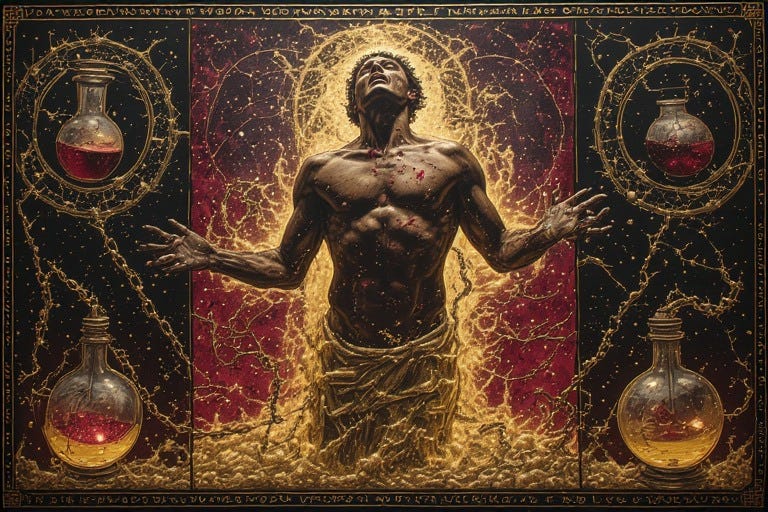
The Return of the Red
Citrinitas, with its golden clarity—that honeyed amber glow which bathes the alchemist’s inner landscape in warm revelation—proves as ephemeral as sunset on polished brass. This solar phase, with its aureate wisdom and crystalline insights, serves not as the journey’s end but as a luminous waypoint—a sun-drenched alcove where the awakened soul pauses, having found its voice amid the echoing chambers of self-discovery, before the ultimate transformation begins. After basking in this golden light, letting it saturate his pores and illuminate the furthest recesses of his being, the alchemist detects a new sensation rising from the sacral vertebrae, coiling upward through each notch of his spine: the return of heat. This differs fundamentally from Citrinitas’s illuminating dawn—it is not the gentle caress of morning light but the urgent press of molten metal. It pulses deeper, like magma beneath thin crust. It resonates more profoundly, vibrating through marrow and sinew. And it is crowned with purpose and power, a coronation of crimson flame atop the golden throne of realized potential.
First comes dissolution—the body surrenders to its own undoing, flesh softening like wax beneath a merciless flame. In the deepest marrow, selfhood melts into primordial sludge, yielding as completely as decay beneath storm-soaked earth, viscous and formless, memories leaking through the lattice. Yet even as identity dissolves, something stirs beneath the breastbone—a whisper of heat, a quickening pulse, like a forgotten seed sensing distant light through layers of darkness, its microscopic tendrils reaching blindly upward.
Next emerges purification. Every cell feels cleansed, unburdened, scrubbed raw by celestial sandpaper, as though spectral tides have washed away all shadows from sinew and spirit, leaving only crystalline essence. Beneath him stretches alabaster ground, both barren and potent—a blank radiance where forms wait to be reborn, vibrating with the tension of imminent clarity, like a canvas humming beneath the painter’s hovering brush.
Then ignition begins. Pale flesh threads with amber, capillaries illuminating like filaments in glass bulbs, then veins flood with gold like sunrise illuminating buried treasure; crimson follows, a living blush that animates the skin, as though perception itself has learned to kindle flame, each pore becoming a miniature volcano erupting with vermilion light.
Finally comes integration. Everything unites in the profound song of blood: vermilion rushing thick and vital, lush as split pomegranate, unbreakable—darkness reborn as a single luminous heartbeat, all fragments united in the body’s consummated fire, organs humming in perfect harmony like instruments tuned to the same sacred frequency, consciousness no longer contained within the skull but pulsing through every cell like liquid rubies.
This is Rubedo, the Reddening—that final incandescent consummation which completes the Great Work. It is the moment when the Philosopher’s Stone finally crystallizes within the alchemist’s own trembling body, its crimson facets gleaming beneath the skin like rubies caught in amber. Every cell that has been calcined to black ash and washed in lunar tears, every fragment that has been torn apart and meticulously recombined, suddenly ignites with purposeful life—a conflagration that begins at the base of the spine and spirals upward through each vertebra until the crown of the head becomes a fountain of vermilion light. Where Nigredo was the obsidian crucible that burned away illusion with merciless flame, and where Albedo was the silver-backed mirror that revealed the naked truth beneath pretense, and where Citrinitas was the golden dawn that awakened consciousness with its honeyed rays, Rubedo is the blood-rich embodiment and sovereign actualization. It is not merely becoming conscious of your power; it is wielding it with the certainty of a king whose scepter has become an extension of his arm. It is not merely understanding your wounds; it is transforming them into gleaming surgical tools that extract poison from others’ flesh. It is not merely surviving the inferno; it is ascending the Crimson Throne to reign over the kingdom of your transmuted being.
The transition feels like the moment when lovers, after hours of careful undressing and tender exploration—fingertips tracing collarbones, lips brushing against eyelids, palms pressing into the hollow of lower backs—finally surrender completely to union. Deliberation gives way to urgent presence; analytical thought dissolves into raw sensation. The boundary between self and other melts away like wax beneath flame, leaving only a single rhythm, a single breath, a single heartbeat echoing through shared flesh, vibrating through marrow and sinew. The brilliance of Citrinitas—that golden, sovereign clarity that once bathed everything in honeyed amber—begins to feel not like triumph but like an elaborate costume waiting to be shed, a performance waiting to be made real. The yellow light that once sufficed now reveals itself as hollow and insufficient, like gilded statues with empty eyes compared to the throbbing blaze of living blood pulsing beneath flushed skin. The queer man begins to hunger not just for visibility but for expression—for the crimson heat of lived, embodied, unapologetic existence that rises from the sacrum and floods the chest with vermilion fire.
The Classical Understanding of the Reddening
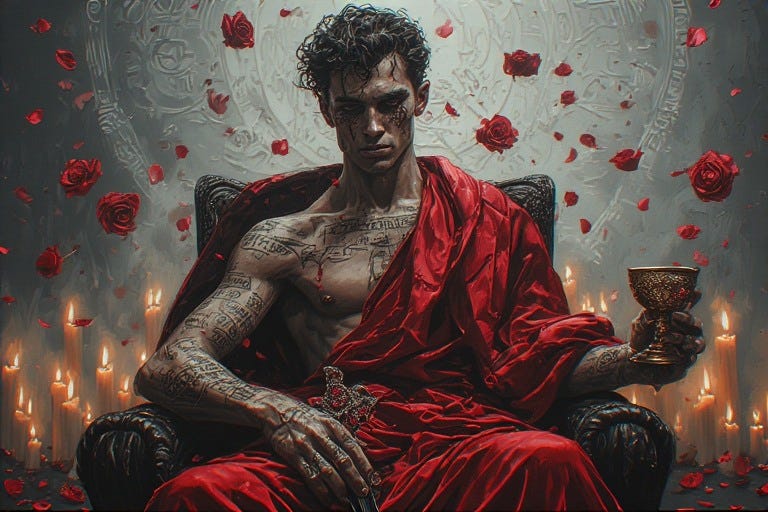
In the yellowed manuscripts of the great alchemists—their vellum pages brittle as autumn leaves, stained with the ochre fingerprints of forgotten adepts, candle wax drippings, and the occasional tear—Rubedo appears surrounded by imagery so luxuriant it borders on obscene in its exuberance. The prima materia, once black as obsidian with its light-swallowing depths and then white as bone dust bleached by desert sun, now throbs with the crimson intensity of arterial wounds bleeding into linen bandages, of damask rose petals crushed beneath calloused bare heels on cold tiled monastery floors worn smooth by generations of shuffling monks, of the sunset over a mercury-still lake when the sky ignites like a glass-blower’s furnace and the entire horizon becomes a linear wound of fire, its edges cauterized by the approaching night.
Ancient alchemical manuscripts—their parchment edges crumbling like autumn leaves, illuminated with gold leaf that catches candlelight in trembling constellations—depict Rubedo as the moment of culmination. Droplets that once fled upward as silvery vapor now gather and descend like tears of mercury. Essences that once escaped through invisible fissures now cling to the vessel’s interior walls in glistening rivulets. Substances that once surrendered to dissolution now coalesce into resilient forms that withstand even the crucible’s blue-white, glass-melting heat. Within the sooty vessel emerges gold unlike any found in royal treasuries or merchant pouches—not the jaundiced yellow of counterfeit coins stamped by sweating forgers, but a profound aureate radiance that pulses like a captured heartbeat, as though the alchemist has somehow distilled the sun’s very marrow into metal. The sages record the birth of the Red Stone in meticulous detail: sometimes appearing as a blood-drenched crystal with facets that seem to breathe, other times manifesting as a translucent crimson mass that throbs with its own internal rhythm, endowed with the miraculous power to transmute lead’s dull gray into gold’s living luster and to transform the pallid flesh of the dying into the flushed vigor of renewed life.
Within Jung’s Red Book—its covers the deep crimson of arterial blood, its pages crowded with his own fevered illustrations rendered in jewel-toned pigments—Rubedo emerges as individuation’s ultimate triumph. This is the sacred moment when the psyche’s shattered fragments meld into a pulsating wholeness that radiates from within like a ruby held to sunlight. Here, Nigredo’s excruciating plunge into shadow—those nights spent wrestling demons in sweat-soaked sheets—transforms from unbearable torment to precious inheritance; Albedo’s merciless self-examination—that mirror that reflects even the pores and scars we wish to hide—becomes not merely cold insight but a scalpel of transformation; Citrinitas’s golden consciousness—brilliant as noon sun on polished brass—ignites not just passive awareness but embodied, unstoppable action. What finally crystallizes bears no resemblance to the static gold masks adorning ancient mummies, but manifests as living solar essence: throbbing with its own heartbeat, regenerating from within, and spilling beyond all boundaries like dawn breaking through mountain peaks.
Yet the ancient texts—their vellum pages worn thin at the edges from centuries of reverent turning, their margins crowded with fevered annotations in faded iron-gall ink—are careful to emphasize: Rubedo is not merely a change in color from obsidian to alabaster to amber to blood-crimson. It is a metamorphosis of essence. The substance that has undergone the full opus does not simply shimmer with ruby brilliance; it has been fundamentally transfigured at the atomic level. It resists corruption like a diamond submerged in acid, maintaining its integrity while lesser materials dissolve. It withstands the furnace’s blue-white heat that would melt ordinary gold to weeping puddles. It exerts a transformative influence on everything it touches—turning lead’s dull gray into solar radiance with a mere grain, healing festering wounds with a single dissolved particle. It has become, in essence, medicine—not just for the practitioner whose fingertips now pulse with vermilion light, but for a world sick with separation.
In illuminated alchemical manuscripts such as the Splendor Solis, Rubedo appears as a crowned figure draped in vermilion robes that cascade like frozen blood around his alabaster throne. His fingers—long, tapered, and adorned with rings of carnelian and garnet—cradle the red-tinted Stone, which pulses with its own internal heartbeat against his palm. The blazing sun behind him casts copper-gold rays that seem to penetrate the vellum itself, warming it to the touch. At his feet, the black crow of putrefaction lies with wings splayed across marble tiles, its obsidian feathers now still as volcanic glass. The white dove of purification, its feathers luminous as moonlight on fresh snow, nestles against the hollow of his throat. The golden lion of solar force reclines beside his right foot, its amber mane rippling with light that seems to flicker and breathe even within the static image. Behind this tableau, a walled city rises—its spires and domes rendered in lapis and malachite, windows aglow with miniature flames, streets teeming with faceless figures awaiting illumination. This imagery encodes an instruction: once the queer alchemist completes his internal Rubedo, he must return to the world, bearing his Stone like a sacrament.
Caput II: The Body as Philosopher’s Stone
The Union of All Contradictions
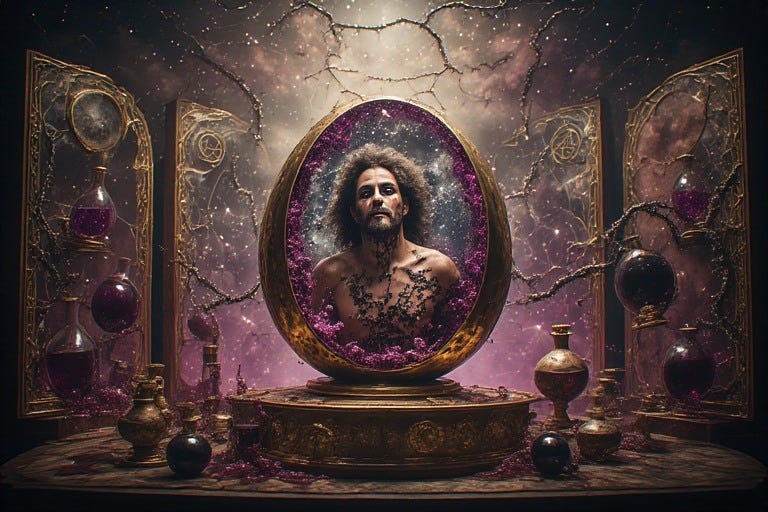
In Rubedo, the body becomes the living paradox resolved—flesh and bone now luminous with vermilion light that pulses beneath the skin like magma beneath the earth’s crust. What once tore the practitioner apart—those midnight wrestlings between flesh and spirit, mortality and transcendence—now intertwine like lovers. The queer male body transforms into a vessel where opposites embrace: matter houses spirit as naturally as lungs cradle breath; mortality carries transcendence like a chalice holds wine; individuality flows into collective consciousness as a tributary joins the ocean; vulnerability becomes strength as a reed bends without breaking in storm winds; and what was hidden now radiates from every pore, turning skin into stained glass illuminated from within. The Queer Alchemist becomes a temple whose walls both contain sacred mysteries and radiate them outward like heat from coals—simultaneously vessel and offering, wound and medicine, the singular “I” and the collective “we” breathing in perfect synchronicity.
In Rubedo, these contradictions do not resolve into a false unity that denies one pole or the other, like a poorly mixed wine that tastes of neither grape nor oak but only of compromise. Instead, they resolve into a dynamic balance where both poles remain true and valid simultaneously, like a dancer who is both grounded and airborne in the same breath, or like the moment when the setting sun touches the horizon—neither day nor night but the luminous threshold between them. The Queer Male Alchemist learns to hold the paradox in his vermilion-glowing palms: I am mortal, my flesh marked with the fine lines of passing seasons, and yet my presence matters eternally, rippling outward like concentric rings in still water. I am vulnerable, my skin as permeable as parchment, and I am invulnerable in my authenticity, standing rooted like an ancient cedar that bends but does not break in storm winds. I am an individual, contained within the boundaries of this particular body with its unique scars and birthmarks, and I am part of the collective transformation, a single crimson thread woven into the vast tapestry of queer becoming.
This is not confusion; this is the sophistication of the completed Work. The Queer Alchemist stands with feet planted firmly on crimson-soaked earth, his body a living vessel where opposites no longer war but dance in perfect synchronicity. Like a ruby that appears different shades when viewed from various angles yet remains a single stone, the Queer Alchemist embodies multiplicity without fragmentation, having descended into shadow’s obsidian depths, integrated the alabaster presence of authentic being, and flowered into the solar-crimson radiance that now emanates from his very pores. His hands bear the scars of his descent into shadow, yet they glow with an inner luminescence that pulses beneath skin that has become both boundary and permeable membrane. When he speaks, his voice carries the resonance of one who has known both the silence of the abyss and the thunderous clarity of revelation.
The Perfection of Embodied Vulnerability
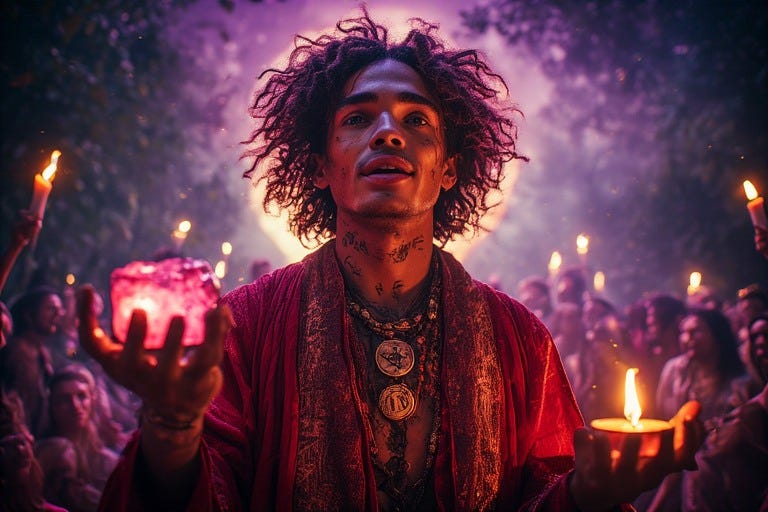
The Rubedo phase reveals a paradox: what the world labels weakness becomes the alchemist’s greatest power. When the queer male body trembles with emotion, bleeds from wounds both visible and hidden, yields to pleasure or pain—this permeability to experience is not a flaw to overcome but the very essence of his magic. For only what can be touched can also touch; only what can be pierced can also receive; only what acknowledges its own mortality can truly celebrate its momentary radiance.
The Queer Male Alchemist in Rubedo stands before his mirror, tracing the vermilion light that pulses beneath his skin like magma beneath earth’s crust. His fingers—adorned with carnelian rings that catch the dawn light—follow the map of scars, stretch marks, and soft places that society once taught him to despise. The vulnerability in his trembling hands becomes the very conduit through which power now flows. Each heartbeat—felt against his palm as he presses it to his chest—reminds him that this vessel is temporary, its rhythm finite. The flesh that will someday return to soil—this chest that rises and falls, these thighs that bear his weight, these lips that speak and kiss and taste—glows now with crimson significance precisely because it cannot last. His desires, once shrouded in shame, now burn like sacred lamps in death’s shadow, their flames all the more precious for their brevity.
In Rubedo, the Queer Alchemist makes peace with mortality itself. His fingertips trace the fine lines forming at his eyes’ corners like delicate spiderwebs catching morning light. When autumn leaves spiral down to carpet the earth in crimson and gold, he no longer mourns summer’s passing but sees in their surrender a reflection of his own journey. Each gray hair that emerges becomes a silver thread in an increasingly complex tapestry. At night, he presses his palm against his chest, feeling the steady drum of his heart—seventy beats per minute, 100,800 per day—each one precious, numbered, and gloriously present.
The Eternal Return Within the Mortal Body
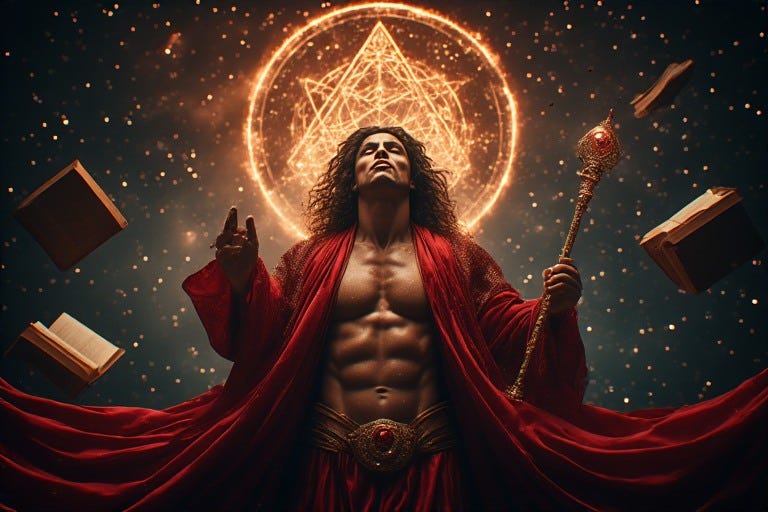
Standing before the vermilion mirror, the Queer Alchemist sees beyond his singular reflection—faces emerge behind him, countless ancestors whose essence flows through his arteries with each heartbeat. His fingertips trace the pulse at his wrist, feeling not just his own rhythm but the drumbeat of generations. This vessel of flesh, temporary in its current form, carries forward an unbroken chain of existence. When his body eventually surrenders to soil, these same atoms will rise again in new configurations, continuing their dance through time—death not an ending but a transformation, a passing of the crimson torch.
Far from a mere consolation prize for his inevitable death, this revelation arrives as ecstatic communion—his temporary flesh participating directly in eternity’s endless dance. The Queer Alchemist stands before his mirror, understanding at last: these hands that will someday return to soil currently hold infinity; this heart that will eventually still pulses now with rhythms ancient as stars. His body no longer separates him from the eternal but instead becomes the sacred vessel through which the boundless pours itself into beautiful limitation, like wine into a chalice, like light through stained glass.
Caput III: The Sacred Fluids as Eternal Substance
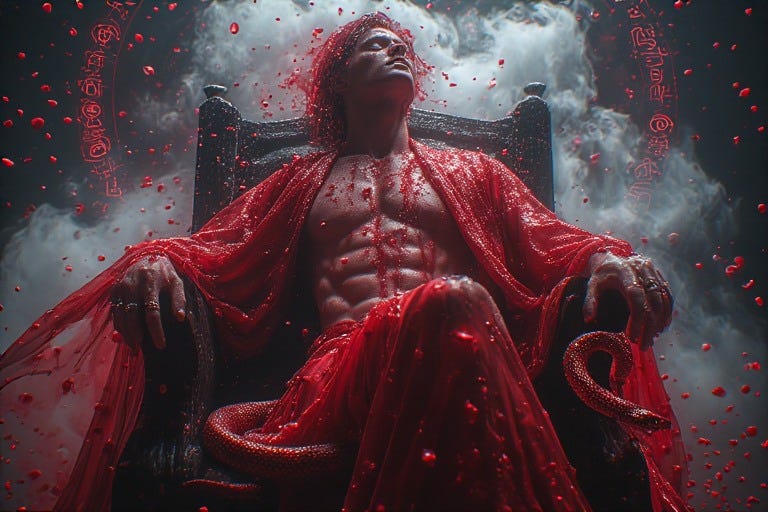
Blood as Covenant with Eternity
The Queer Alchemist in Rubedo holds his palm to candlelight, watching crimson glow through flesh. His blood—this ancient fluid coursing through his veins—reveals itself not merely as life’s current or power’s essence, but as the living testament that binds him to all existence: to ancestors whose hearts once beat with the same rhythm, to future generations yet unborn, to every creature whose pulse echoes his own.
With each pulse, the Queer Male Alchemist’s veins carry more than mere sustenance—they course with the living memory of those who preceded him. His crimson tide bears the essence of both blood relatives and spiritual forebears: the gender-transcendent healers, the twilight-dwelling visionaries, the flame-keepers who preserved their sacred truth beneath society’s crushing weight. When he presses fingers to wrist, feeling that steady rhythm, he touches not just his own mortality but the unbroken crimson thread connecting him to their enduring legacy. When he presses palm to chest, he feels not one heartbeat but countless— the rhythm of a chorus spanning centuries, still singing.
Through his veins pulses the crimson promise to future generations—queer children not yet born who will walk the path he now clears with each authentic breath and gesture. Though society wielded shame like a blade to sever this sacred lineage, his blood carries forward what cannot be destroyed. In his heartbeat echoes the rhythm of a thousand queer ancestors, and in his body lives the seed of a thousand queer tomorrows.
When the Queer Alchemist in Rubedo beholds his own blood—crimson droplets welling from ritual cut, scarlet smear across ceremonial tools, or ruby beads drawn for mundane medical tests—he witnesses not just vital fluid but time itself made manifest. Each pulse through his veins carries forward ancestral memory while simultaneously reaching toward futures yet unwritten, binding him in a covenant that transcends death’s supposed finality.
The Seed of Continued Becoming
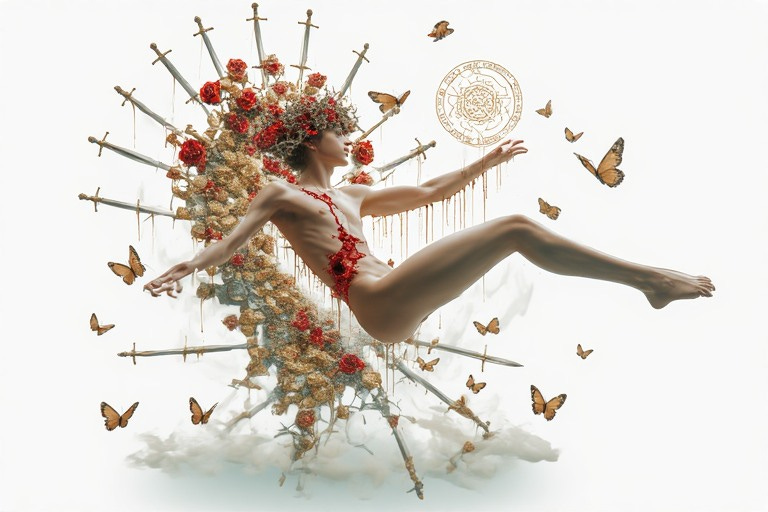
The Queer Alchemist in Rubedo sees his seed as more than mere reproductive matter—it embodies the distilled quintessence of perpetual transformation. Beyond biological offspring, it carries forward the living current of queer knowledge, tradition, and existence that flows through generations despite attempts to dam its course.
The Queer Male Alchemist standing in his Rubedo phase becomes a living flame. His existence—childless or not in the biological sense—casts light into shadowed corners where others still hide. When he walks through the world without diminishing himself, those who glimpse him from their closets feel something stir within: possibility. His authenticity becomes contagious. People who encounter him carry away embers of transformation, finding themselves inexplicably warmed, illuminated from within by something they cannot name but suddenly cannot live without.
Thus, the queer man’s seed carries dual power—physical substance and spiritual essence combined. Each drop contains encoded memories of survival against erasure, the crystallized knowledge of those who found ways to love despite prohibition. When heteronormative forces sought to eliminate these lineages, they failed to understand: queer wisdom flows not just through blood relations but through the sacred transmission that occurs whenever queer bodies dare to exist authentically, to love fearlessly, and to transform the very world that tried to destroy them.
Tears as the Fluid of Compassion and Witness
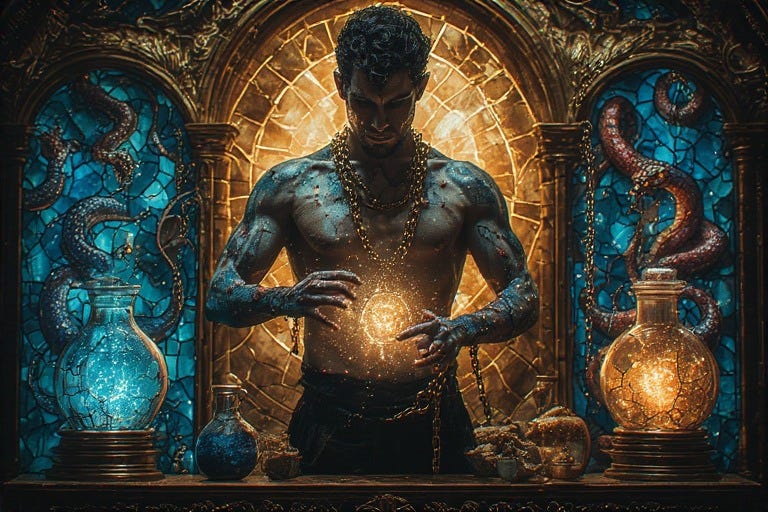
Tears, within the Rubedo phase, transform into sacred witnesses—droplets that crystallize the moment when the soul recognizes suffering, acknowledges beauty, and surrenders to the overwhelming current of existence flowing through the vessel of the body.
Salt rivers flow from the Queer Male Alchemist’s eyes in Rubedo—no longer mere personal catharsis but communion with collective wounds. Each droplet carries memories: the teenager who stepped from a bridge, the elder who died nameless in hospice, the child whose effeminacy was beaten into submission. Yet these same tears glisten with reverence for drag queens who dance through hatred’s gauntlet, for lovers who clasp hands amid glares, for every queer body that rises each morning to breathe defiance against a world that wished for its disappearance.
Each salt-bright droplet carries consecration in its fall—no longer shame’s evidence but testament to a heart fully awakened. When the Queer Alchemist weeps in Rubedo, his tears declare what society tried to drown: this body refuses numbness, this soul embraces both the world’s wounds and its impossible beauty.
Sweat as the Fluid of Sacred Labor
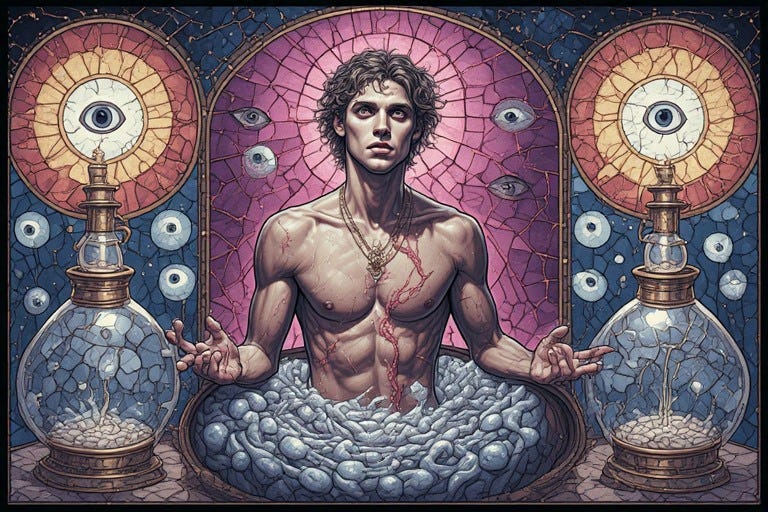
Sweat glistens on the Queer Alchemist’s brow, each droplet a testament to labor unfinished. His body, slick with effort, embodies the eternal process—muscles tensing, releasing, transforming potential into motion. This sacred perspiration marks not completion but continuation, the living proof that transformation demands perpetual movement.
The Queer Male Alchemist in Rubedo stands at the threshold of completion yet knows he has merely begun. His transmuted flesh still carries ancient wounds that reopen in unexpected moments. The world outside his chamber continues to regard bodies like his as profane rather than holy vessels. Each morning brings both the triumph of survival and the labor of creating sacred space where none existed before. His hands never rest from their building, his heart never ceases its alchemical fire.
Beads of moisture glisten on his skin—sacred evidence of labor in the Great Work. Like a forge radiating heat, his body emanates warmth that touches those around him, kindling in them the first spark of their own potential metamorphosis.
All Fluids as the Waters of Life Continued
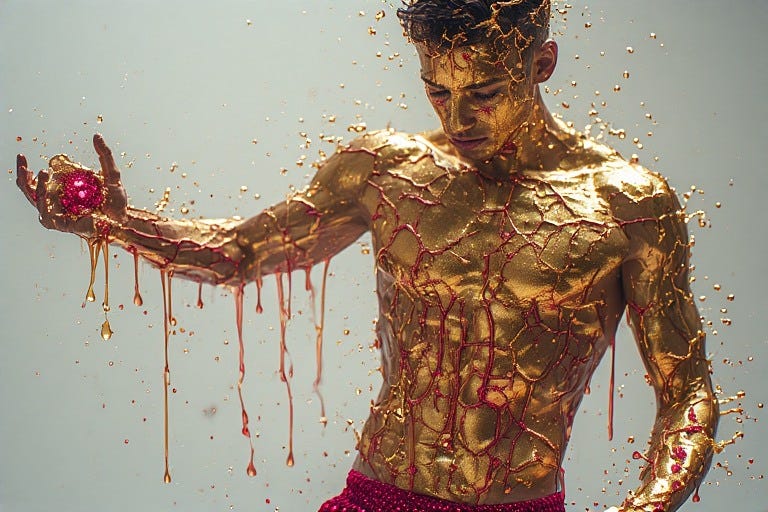
The Queer Alchemist in Rubedo holds a goblet of his own making—a vessel containing droplets collected from his body’s many fountains. Within this chalice, substances once deemed profane now shimmer with sacred potential: the salt of tears, the iron tang of blood, the milky essence of seed, the amber filtration of kidneys, the slick evidence of exertion. He sees how each carries the same molecular memory as rain and sea, each a different dialect of the same primordial language that has flowed through every creature since life’s first stirring.
The Queer Male Alchemist in Rubedo stands before his altar, droplets of sweat and tears mingling in the chalice. As he raises it to candlelight, the liquid catches fire-glow, revealing not separate substances but a single shimmering essence. His fingertips trace the rim, feeling the boundary between vessel and void dissolve. The revelation arrives not as thought but as bodily knowing: these waters that comprise him—blood, tears, seed—are the same waters that have flowed through all beings since the first ocean birthed life. His flesh, once perceived as exile, now recognized as confluence.
Caput IV: The Crimson Throne—Power Reclaimed and Embodied
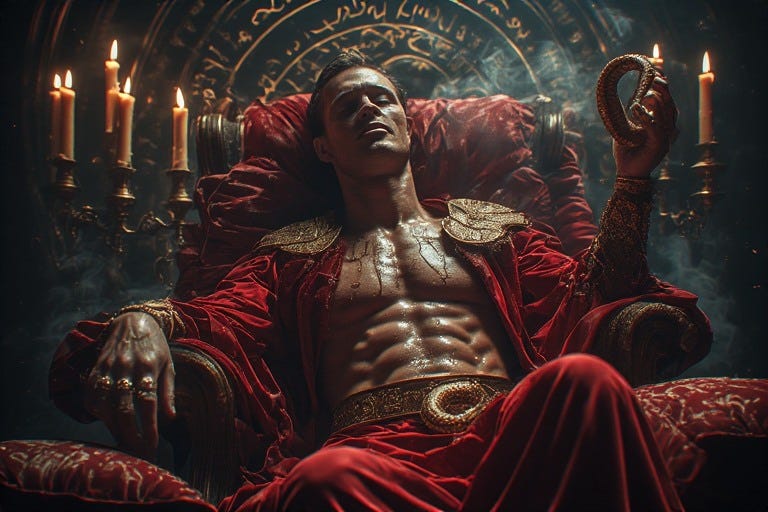
The Return to Sovereignty
Having endured the excruciating descent into shadow during Nigredo, emerged purified through Albedo’s lunar stillness, and awakened to his authentic voice in Citrinitas’s golden dawn, the queer man now stands at the threshold of his birthright. Before him lies what generations of heteropatriarchal structures have labeled dangerous, what religious doctrines have deemed sinful, what medical institutions have pathologized as disorder: his own sovereign power.
This is not the power that seeks to control others—such domination belongs only to those whose inner emptiness demands constant feeding. This is instead a power that emanates naturally from his center like warmth from flame, requiring neither explanation nor external validation. It simply exists as the inevitable expression of a self finally made whole.
You stand within a cathedral of transformation. Ruby light streams through jeweled windows, gilding brass fixtures and washing over marble floors threaded with crimson veins. The atmosphere hangs heavy with potential—saturated like mulled wine left to steep. Your physical form has journeyed through the alchemical stages: from Nigredo’s defensive armor, through Albedo’s cautious restraint, past Citrinitas’s first bold stance. Now in Rubedo, power courses through you like electricity. Muscles that once braced against danger or performed for approval finally serve their true purpose as conduits of intention. When you speak, your voice no longer quavers or merely clarifies—it resonates with the authority of bronze struck at zenith, commanding attention without demanding it.
Rubedo’s transformation arrives not as theory but as lived experience: one morning, you simply notice the absence of questions that once consumed you. The internal voice that constantly sought permission—”May I take up space? Are my longings permissible? Will others tolerate my feelings? Is there room for me here?”—has fallen silent, replaced by a steady heartbeat of certainty.
The anxious interrogations that once kept you vigilant now fall away like shed skin. In their place: a crimson silence at your core. No justification needed. No permission sought. Only the weight of your presence in the world—complete, necessary, and finally recognized as such by the one who matters most: yourself.
The alchemist who reaches Rubedo ceases the exhausting theater of self-presentation. Gone is the constant calibration of voice and gesture to appease imaginary critics. Vanished is the online arithmetic of validation—likes, shares, profile views—that once defined his value. In their place stands a man who moves through the world with the quiet certainty of one who has already survived immolation, who has held steady gaze with his reflection at its most terrible and beautiful, and who wears his sovereignty not as costume but as skin.
The Four Crowns of Rubedo
When the queer male alchemist crosses the ruby threshold into Rubedo’s final chamber, four distinct realms of power unfold before him like petals of a crimson flower, each realm bearing its own gleaming crown of self-mastery.
First Crown: The Crown of Sexual Sovereignty
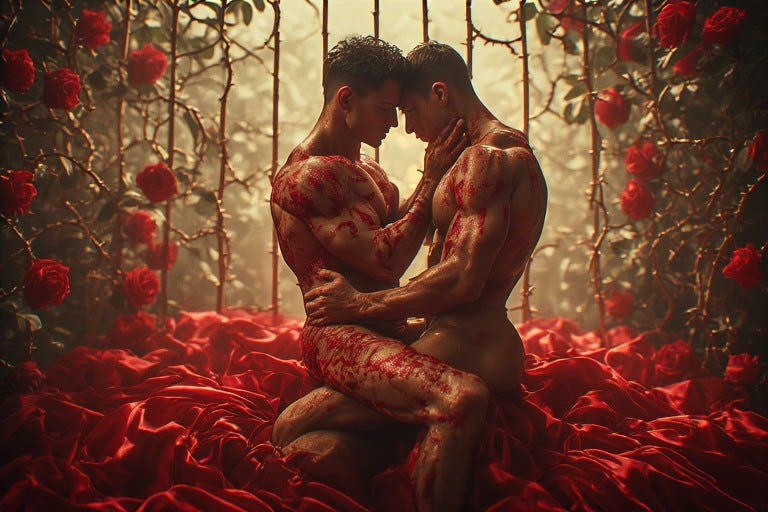
Having walked through the black fire of Nigredo, washed himself in Albedo’s silver waters, and found his voice in Citrinitas’s golden light, the queer male alchemist now stands before Rubedo’s final mystery. Here at last, the body’s hungers—those desires he once buried, disguised, or apologized for—reveal themselves not as sins to overcome but as sacred pathways. What society named shameful, what religions condemned as abomination, what he himself once feared as weakness, now pulses with holy significance. The flesh becomes not obstacle to spirit but its very temple.
What was once battlefield and crime scene transforms into sacred ground.
Witness the Queer Male in Rubedo as he joins with another in intimate communion. Fingertips trace constellations across skin with deliberate purpose. Lips whisper incantations against collar bones. Inhales and exhales become rhythmic invocations. Previously, he existed divided—one self participating while another hovered above, scrutinizing every move, every sound, every expression for acceptability. Now, he inhabits his entirety.
The phantom observer has dissolved. Gone is the critical spectator measuring his worth. Vanished are the judgmental shadows of authority figures and societal expectations.
Through his flesh runs the memory of each stage: Nigredo’s dark baptism in his own once-scorned fluids, Albedo’s patient washing away of ancient shame, Citrinitas’s first brave utterance of desires long silenced. Now in Rubedo, as skin meets skin, the sacred and profane collapse into one another—each touch becomes both prayer and answer, each shared breath both invocation and blessing. Lubricant glistens like chrism oil. Pre-cum shines like anointing. What was once labeled “risk” or discarded as “waste” transforms into sacred essence—a vital fluid exchanged in mutual consent, carrying the power to forge connection, consecrate moments, and ignite the body’s hidden currents.
The Queer Alchemist in Rubedo no longer moves through his desires as a fugitive. Where once he sought validation or rebellion, now he stands in sovereign choice. He approaches potential lovers with the calm certainty of one who knows his own worth—not grasping from desperation but selecting from wholeness. His intimate practices arise from authentic impulse rather than prescribed performance. A casual encounter becomes a temple of presence; a committed bond retains its wilderness; even seasons without coupling bear fruit. He has reclaimed every expression of his desire, liberating his body from narratives that never recognized its inherent divinity.
To claim the Crimson Throne is to finally inhabit your birthright:
He can say yes without guilt.
He can say no without explanation.
He can negotiate, renegotiate, and withdraw consent without self-hatred.
He can seek pleasure without apology.
He can disclose vulnerability without terror.
His desire no longer presents itself as a crisis requiring intervention. Instead, it flows through his physical form like changing weather—gentle rain one day, overwhelming deluge the next, occasional periods of stillness—each manifestation containing wisdom to be received rather than a deviation to be corrected.
Second Crown: The Crown of Authentic Speech
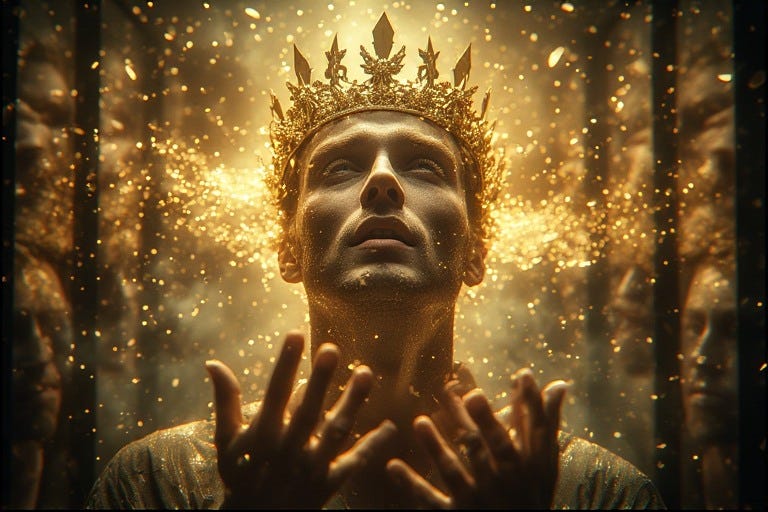
His voice has traveled a long alchemical path: from Nigredo’s strangled whispers, where words caught like thorns in his throat or turned inward as weapons against himself; through Albedo’s crystalline analysis, where he first named his patterns with clinical precision; into Citrinitas, where he claimed the right to speak his vision with the directness of sunlight. Now in Rubedo, something profound has changed—his words no longer merely communicate but consecrate. The Crown of Speech has found its rightful throne upon his tongue.
The power lies not in how loudly he speaks or how artfully he phrases his words. A Rubedo man might barely raise his voice above a murmur, or he might fill a room with his declarations. What matters is the seamless flow between his deepest knowing and his spoken truth. When he opens his mouth, what emerges carries the unmistakable weight of authenticity—words that have traveled the full distance from his core to his lips without distortion or dilution.
His tongue no longer forms the apologetic preambles that once guarded his truth:
“Sorry, this might be stupid but...”
“I don’t know if this makes sense, but...”
“I’m probably overreacting, but...”
“I’m not an expert, but...”
His words now emerge unadorned, stripped of apology, standing naked in their truth:
“This is what I know.”
“This is my experience.”
“This is my boundary.”
“This is what I will and will not allow.”
His words no longer float like disembodied thoughts but pulse with the rhythm of his lived experience. Each syllable carries the earned weight of his journey—not theoretical but incarnate. Pain, when he speaks of it, becomes neither spectacle nor weapon but simply testimony. Injustice transforms in his mouth from righteous complaint to a clear-eyed calling forth of what could be. And when desire crosses his lips, the invitation stands naked, neither disguised as something else nor wielded to control, but offered as one sovereign being to another.
The Crown of Speech transforms silence from a defensive reflex into a sovereign choice. Where once he swallowed words to avoid conflict, now he withholds them to honor deeper truths. His listening carries weight—not the vacant nodding of self-erasure but the full-bodied presence of one who knows his own boundaries remain intact. When pressed beyond what he wishes to reveal, “I prefer not to discuss that” flows from his lips without apology, his center holding steady.
Third Crown: The Crown of Creative Manifestation
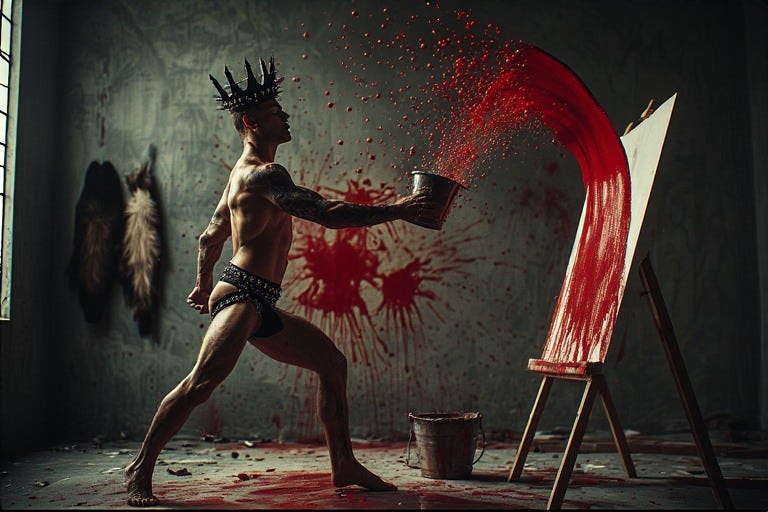
The blackness of Nigredo left him gasping for air as he learned to tread water in his own emotions. Through Albedo’s silver light, he catalogued and scrubbed clean the artifacts of his past. Citrinitas sparked the golden flame that illuminated his purpose and loosened his tongue. Now, in the crimson glow of Rubedo, his transformed essence crystallizes into tangible form. Creation flows from his hands.
Through the Crown of Creative Manifestation his hands become vessels of power, each gesture and daily task infused with alchemical intent. The mundane transforms into sacred text—an email composed with crystalline precision, a meal prepared as devotional offering, casual sex elevated to ceremonial exchange. Some men will channel this energy into art: canvases blooming with color, stages ignited by movement, pages filled with incantations. Others will embody it through social justice, healing work, guiding communities, tending spirits, raising children, or perfecting their craft.
Unlike before, his creations now flow from abundance rather than from the hollow ache of seeking validation.
He does not write to be forgiven.
He does not perform to be validated.
He does not lead to avoid abandonment.
He creates because the Stone within him must radiate.
His work becomes an extension of his nervous system’s peace, his body’s erotic intelligence, his soul’s hard-won clarity.
His creations carry an unmistakable presence that touches those who encounter them, a subtle yet profound disturbance in their field of awareness. His work possesses a certain weight, an undeniable substance that commands attention without demanding it. What he has forged in the crucible of his transformation has become permanent, immutable. The essence he has distilled into his creations remains, resistant to dissolution, impervious to erasure.
Fourth Crown: The Crown of Conscious Generosity
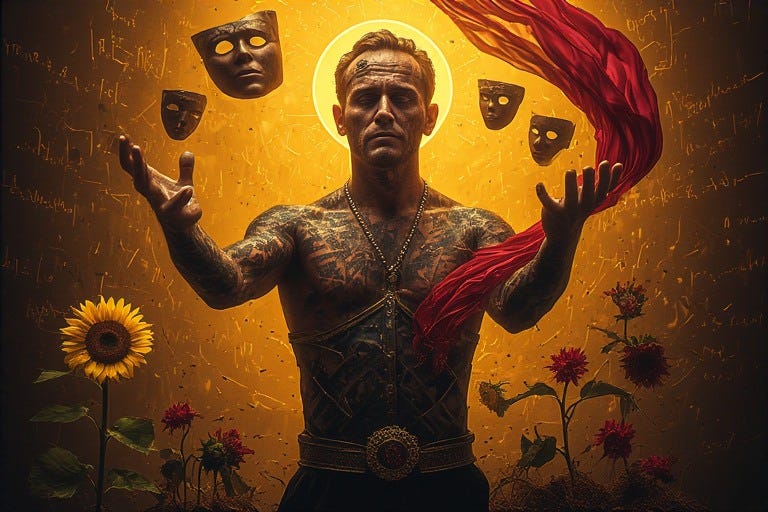
Society trains queer men to deplete themselves—offering endless emotional support while their own cups run dry, creating welcoming spaces in hostile terrain while their own bodies remain unwelcome, and sharing their artistic gifts for the consumption of others while receiving crumbs of recognition in return. During his darkest moments, the alchemist gives because he believes he deserves nothing, his hands trembling as they hold others up while his own knees buckle beneath him. As he begins healing, he pulls away like a wounded animal retreating to its den, curling protectively around the fragile ember of his newly discovered self-worth. When his confidence grows, unfurling like a crimson banner, he discovers the sacred syllable of “no” forming on his lips without apology. Finally, in his fullest expression, he achieves the perfect equilibrium of the philosopher’s stone—generosity flowing like rich, oxygenated blood from the chambers of his abundance rather than leaking like plasma from the wounds of his emptiness.
His generosity flows from a steady hand, no longer trembling with the fear of depletion. Now he stands in his power to:
Guide others along the path without requiring adoration in return.
Honor the achievements of others without secretly measuring his own worth against them.
Give to others without becoming a sacrifice.
Share his heart’s depths without surrendering his sovereignty.
Where once he was a well running dry, now he overflows like a fountain. The energy no longer wasted on shame management becomes abundance seeking expression in the world: the table set for friends who need nourishment, the sanctuary created in hostile spaces, the quiet transfer of funds to those in need, the wisdom offered without expectation, the midnight invocations spoken for those who cannot yet speak them for themselves.
True generosity transcends mere pleasantness. Sometimes it manifests as fierceness, the hand that pulls back a brother from his own destruction, the voice that speaks truth when others whisper comfortable lies, the body that becomes a shield against predatory systems. Other times it flows as quiet presence, the ear available at 3 a.m., the steady breathing beside a hospital bed, the anonymous transfer of funds when rent comes due. Whatever its form, this giving springs from the alchemist’s deepest understanding: the gold refined within his crucible must be circulated beyond himself.
Caput V: The Hermetic Exaltation—Reclaiming the Divine Masculine
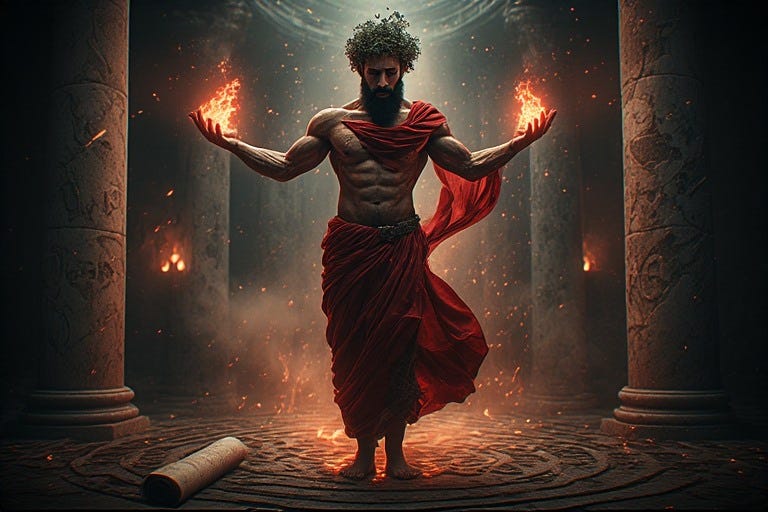
The Crowned King: Beyond Patriarchy, Toward Sacred Masculinity
The queer male has long faced an impossible binary: either perform the rigid theater of patriarchal manhood, spine stiffened, emotions locked away, control maintained at all costs, or cast masculinity itself into exile, as though strength and assertion were poisons rather than powers. Each path demands sacrifice of essential parts of himself.
Beyond the false binary emerges a third possibility: the Divine Masculine—not as theoretical construct but as living presence. This is masculinity transformed through alchemical stages: purged in Nigredo’s flames, washed in Albedo’s silver light, illuminated by Citrinitas’ golden rays, and finally embodied in Rubedo’s crimson pulse. Ancient alchemists recognized this achievement as the Crowned King who sits not on a throne of dominion over others, but of sovereignty within himself. His kingdom? The integrated territories of body, psyche, and spirit.
What qualities define this realized masculine presence?
Rooted: His stance solid as bedrock, his hips alive with purpose, his lungs drawing power from depths most men never access.
Open-hearted: Heart neither hidden behind walls nor left vulnerable to every passing wound—a sanctuary whose gates open and close with intention.
Clear-headed: Intellect like a blade that cuts through confusion without drawing blood, seeing patterns clearly while remaining fully present in his body.
Erotically alive: Sexual energy neither worshipped as salvation nor rejected as sin, but recognized as a sacred current flowing through his being.
Religious authorities may speak, but his conscience answers to a deeper voice. Institutions may grant credentials, but his authority rises from within. Lovers may offer insight, but his intuition remains sovereign. He listens to them all—sometimes with great care—yet the final decision crystallizes in his own palm, weighty as a scepter, unmistakably his to bear.
His presence shifts the room’s atmosphere without fanfare. Shoulders square, spines lengthen—not from intimidation but as if each person remembers their own dignity in his company. Conversations deepen almost imperceptibly; the usual social scripts fall away. Though his laughter comes easily and often, something about his gaze invites authenticity rather than performance, as if the air itself has become too dense to support anything less than truth.
The Alchemical Marriage: Integration of All Opposites

The crimson phase marks the moment when opposites no longer war within the flesh—when the royal marriage of solar and lunar forces achieves lasting consummation. What once flickered unstably between poles now fuses into living paradox. The queer man’s body becomes the bridal chamber where these forces consummate their union, no longer merely theoretical but viscerally present in every cell as:
Masculine and feminine
Active and receptive
Penetrating and enveloping
Speaking and listening
Holding and being held
What society once labeled “femme” and taught him to bury now rises to the surface, not as deficiencies to compensate for or ornamental additions, but as foundational elements of his sovereignty. His tenderness stands equal to his boldness; his aesthetic discernment requires no defense; his emotional intelligence demands no apology. Simultaneously, the qualities society deemed acceptably “masculine”, his resolute will, his bodily vigor, his carnal hunger, his drive to achieve, take their place in his inner court without dominating the proceedings. In his realm, no aspect of self lives in exile or claims supremacy. From this balanced integration emerges a discovery:
The man who cries openly and still terrifies injustice.
The man who loves deeply and still walks away when necessary.
The man who wears softness on his face and steel in his spine.
The man who submits erotically without surrendering dignity.
The man who dominates erotically without abandoning compassion.
Within him, sovereignty no longer divides into warring factions of masculine and feminine. The throne room of his being hosts a single unified presence—regal yet tender, assertive yet receptive. This inner royalty understands that power flows not from dominance of one aspect over another, but from their perfect communion: each quality illuminating what might otherwise remain hidden in the other, each capacity expanding through their sacred marriage.
Caput VI: The Consummation of the Great Work
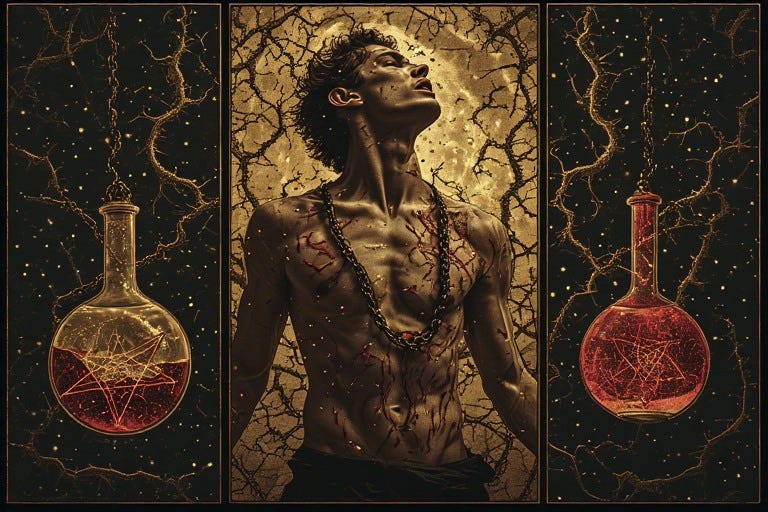
When the Stone Finally Crystallizes
The alchemical process culminates in a moment of recognition, it might strike with lightning’s sudden clarity or emerge with the slow inevitability of daybreak, where you lift your eyes to find the night has already surrendered to blue. In this instant, you understand that one cycle of the Work has reached completion. The transmutation stands accomplished. Where the Philosopher’s Stone was once potential, now it exists as crystallized reality. You have crossed the threshold from becoming into being, from process into presence.
The revelation often arrives through mundane moments:
Standing before the bathroom mirror as morning light filters through the blinds, toothbrush in hand, and noticing with quiet surprise the absence of your usual internal criticism.
Stepping into a crowded gay bar and realizing your body hasn’t tensed, your eyes aren’t darting between bodies to measure yourself against them, your breath hasn’t shortened into that familiar rhythm of not-enough.
Hearing “no” and feeling the sting without your foundations crumbling beneath you.
Realizing, as you sit in the quiet of your apartment on a Friday night, that the silence no longer hunts you—it nourishes you instead.
You notice:
That constant radio frequency of loathing that once played beneath your every thought has finally gone silent.
Your vigilance—that perpetual radar sweeping for threats—now rests in peaceful stillness.
The desperate grip with which you once clutched at achievement, validation, and perfection has finally begun to release its stranglehold.
The cage dissolves. The lungs remember. The self returns.
When the Great Work reaches its crimson culmination, suffering does not vanish from the alchemist’s life. He will weep at funerals, battle disease, nurse the wounds of abandoned love, face betrayal’s knife, and stand against the machinery of oppression that grinds against queer bodies. Yet where once he might have seen divine retribution or personal failing written in these hardships, he now recognizes them as atmospheric conditions—violent storms or gentle rains that pass over the landscape of his being without defining it.
His inner dialogue shifts from self-accusation to sacred curiosity—no longer “What defect lies within me?” but “What wisdom does this moment demand?”
The clock’s tyranny dissolves. Where once he raced toward tomorrow’s promised worthiness, now he inhabits his sovereignty fully, crowned not by what might someday be, but by what already exists within his flesh. He claims his throne in the present moment, while still gazing toward horizons that remain unwritten. The difference? His value no longer waits there to be earned.
The Vermilion Legacy: Passing the Torch

The Philosopher’s Stone cannot be contained. This is Rubedo’s most profound revelation: transformation spreads beyond the vessel that achieved it. A queer man who has completed the Great Work becomes a living catalyst. He need not preach or publish. His very presence, the rhythm of his breath, the steadiness of his gaze, silently alters the molecular structure of spaces he inhabits.
He transforms into a living ancestor, regardless of his readiness for such a mantle.
The queer ancestral line includes those who still breathe among us—men who navigate crosswalks, reply to messages, lose themselves in nightclub rhythms, guide students, and appear in digital windows. Ancestry in this tradition stems not from years accumulated but from wounds alchemized into wisdom. The Rubedo man carries within his body the memory of locked doors, the body’s memory of violence, 3 AM self-loathing, contemplated endings, carefully constructed lies, desperate coupling, chemical escapes, and gnawing emptiness. Yet equally vivid in his cells: the precise instant when each poison first became medicine.
When a younger queer man sits across from him, voice breaking as he confesses his self-loathing, the Rubedo man meets his gaze without flinching. No empty reassurances cross his lips. No toxic positivity. No spiritual bypassing. Instead, he leans forward slightly, the lamplight catching the fine lines around eyes that have witnessed both desolation and dawn. “I hear you,” he says, his voice a steady anchor in turbulent waters. “The path through that darkness exists. I’ve walked it.”
He stands as living evidence.
The Vermilion Legacy travels through bodies, not manifestos. His steadiness resembles not the naïveté of the untested but the weathered composure of one who has survived a thousand internal wars. When his palm rests on a younger man’s quaking shoulder, an invisible current flows between them—an inheritance beyond language, a cellular remembering, a template for possibility. The younger man’s body registers what his mind cannot yet articulate:
Here stands living evidence that the journey can be completed.
Caput VII: The Shadow of Rubedo—Inflation and the False King
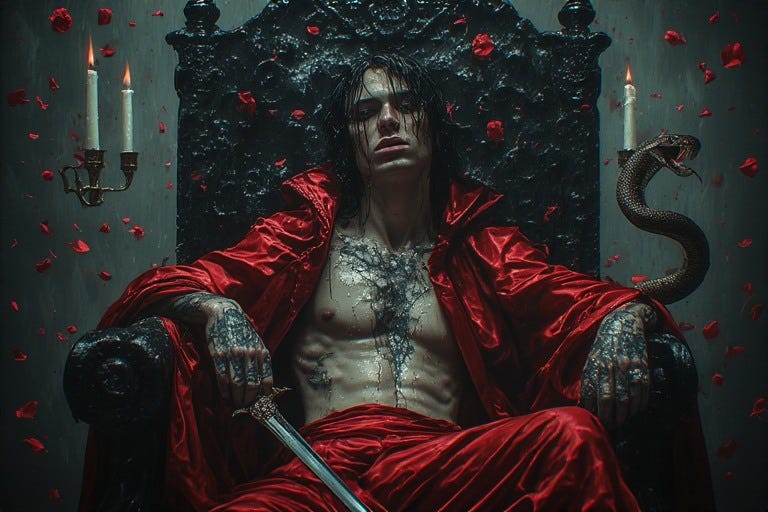
The Crimson Trap
Yet even here, at the summit of achievement, danger lurks.
Without the constant companions of humility and remembrance, Rubedo’s transformative fire can burn out of control. Like a bodybuilder whose swollen muscles tear their own tendons, the spiritual vessel may rupture under its own power.
Watch how the False King perches upon his blood-red throne. See how he mistakes himself for the Stone rather than its temporary caretaker. Listen as he proclaims his unique enlightenment, his indispensable wisdom, his singular authority over others’ journeys. His once-freeing words calcify into dogma. His boundaries, erected for health, become fortress walls. His throne, meant for service, transforms into a citadel where he rules alone.
Signs of Rubedic Inflation:
He bristles at the slightest pushback, his shoulders tensing and eyes hardening when others question his wisdom—as though their doubt were a knife aimed at his heart rather than a natural part of human discourse.
He cultivates a court of admirers whose need for his wisdom validates his existence, flinching when they begin to stand on their own.
He transforms his journey of healing into a cudgel of judgment, brandishing his own survival as evidence against those still submerged in their suffering.
He mistakes the spotlight for spiritual evolution; his sense of worth rises and falls with the number of followers, likes, and views he accumulates.
He regards other queer men still struggling with their shadows with a subtle condescension masked as compassion, his eyes betraying the unspoken judgment that they occupy a lesser circle of evolution.
Watch how the False King wields sacred terminology as camouflage for domination. Listen as he invokes “healthy boundaries” while systematically cutting others off from alternative perspectives. Notice his eloquent sermons on “shadow integration” delivered from behind carefully constructed personas that hide his unhealed wounds. Observe his passionate teachings on “embodied wisdom” even as his bloodshot eyes, trembling hands, and ragged breath betray his body’s desperate plea for rest.
The Antidote: Remembering the Ash
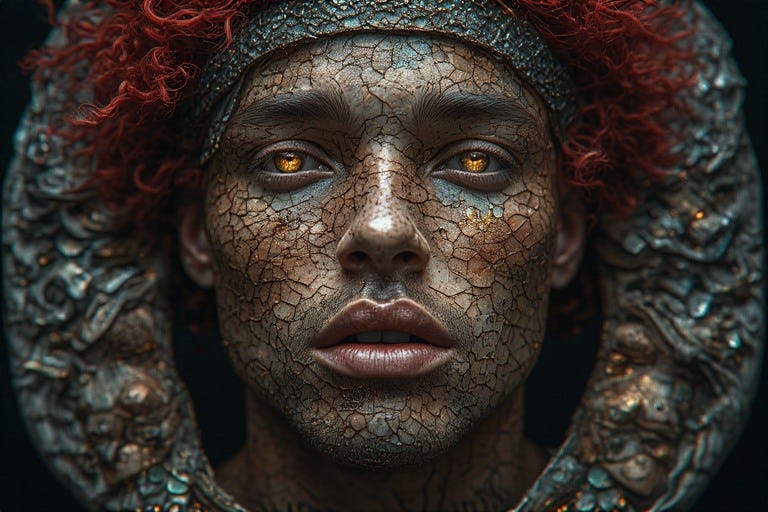
When the Rubedo man feels his crown growing too heavy, his remedy lies not in returning to the pit of self-loathing, nor in questioning his every perception, nor in frantically demonstrating his right to rule. These medicines belonged to earlier stages. Now, his healing comes through the simple act of looking back—of touching the scars that made him and honoring the ashes from which he rose.
The Crowned King who forgets his origins will find his throne turning to ash beneath him. Thus, the Rubedo man must return to these practices:
Return to the memory of his own Nigredo: the weight of blankets like concrete slabs pinning him to the mattress, the 3 AM whispered bargains with any god who would remake him into someone acceptable, the searing moments of shame that still flare like phantom limbs when least expected.
Revisit the humility of Albedo: recalling the countless times he mistook the funhouse mirror of his mind for an accurate reflection, the years spent mistaking his inner critic’s voice for divine judgment, the grueling labor of scrubbing clean the lens through which he viewed himself and others.
Honor the trembling vulnerability of Citrinitas: recalling the first time he spoke and his voice emerged deeper than expected, how his knees trembled as he stood to address the circle, how his palms left damp prints on his robes as he claimed space that had always been his birthright.
The Rubedo man must serve where cameras cannot follow—washing dishes at the community center after others have gone home, listening to a struggling youth with no social media post to commemorate it, tending plants that will bloom long after his departure.
Such invisible devotions keep his crown permeable to light. Without them, sovereignty hardens into isolation.
The true King never abandons communion with his own Ash—those grey remnants from which he rose, the calcined bones of his former selves. When he touches that dust with reverent fingers, remembering how completely he once burned, tyranny cannot take root in him. His scars whisper humility into his ear just as his crown begins to weigh too heavy.
Caput VIII: Rituals of Rubedo—Practices for Embodying the Crimson Throne
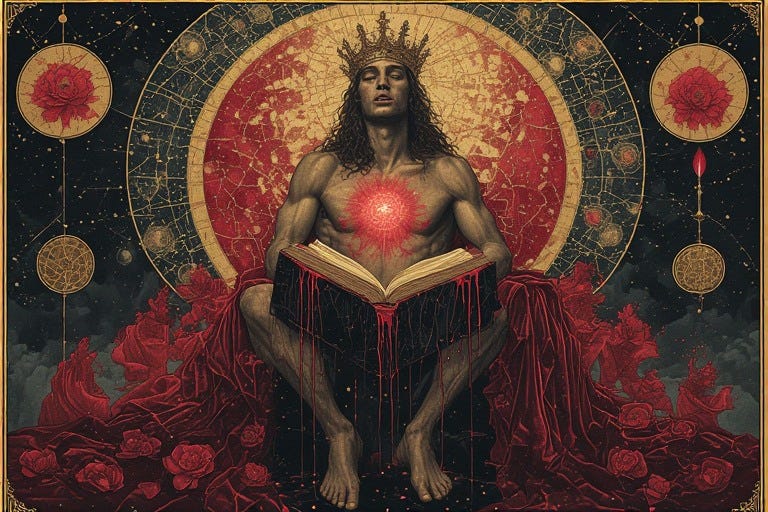
Operation I: The Lighting of the Scarlet Flame
Purpose: This ritual awakens the crimson fire at your core, that radiant power which emerges only after your queerness has been fully embraced rather than merely tolerated. Through these acts, you’ll summon and embody what has always existed within: the sovereign solar force that transforms shame into sacred authority.
The Setup:
Create an altar that revels in crimson abundance. Restraint has no place in this sacred space.
Cover your altar with crimson fabric—choose velvet that swallows light or silk that makes it bleed across the surface.
Set a substantial crimson taper, nestled within a vessel of burnished metal that catches the light, at the heart of your sacred space.
Add:
A pomegranate split open to reveal its crimson chambers, each seed a jewel of blood-bright possibility.
A stone of deep crimson, jasper’s earthy power, carnelian’s fiery vitality, or ruby’s royal brilliance, placed where candlelight will ignite its depths.
A vessel brimming with crimson liquid, whether the fermented blood of grapes, the steeped petals of hibiscus, or the pressed seeds of pomegranate.
A small bowl of salt stained crimson with paprika or red ochre, Earth’s body transformed by fire and blood.
A looking glass positioned to reflect both the dancing flame and your own visage.
The Ritual:
Begin as the sun descends, when crimson bleeds across the horizon in nature’s own Rubedo.
Position yourself before your altar, your body either bare or draped in scarlet fabric. Root yourself—feel the earth’s pull through your feet, the weight of your body settling downward, your center of gravity anchored in your pelvis.
Ignite the candle. Observe its transformation of matter into light and heat. The flame makes no compromise; it simply exists in its full power.
Rest your stronger hand upon your heart center, your other hand upon your sacred core below. Breathe deeply into this connection. As you draw breath inward, envision pulling the candle’s radiance into yourself—not as an external force, but as an awakening of the identical flame that has always resided within you.
Speak aloud:
“I am the Crimson Flame.
I burn without shame.
I illuminate without apology.
I radiate my truth into the world.
In my radiation, others find their own light.
I claim my body as sacred.
I claim my voice as sovereign.
I claim my desire as divine.
I am whole—and from my wholeness, I serve.”
Place a single pomegranate seed upon your tongue (or take a sip of the crimson liquid). Before swallowing, allow yourself to experience its complexity—the sharp tang yielding to unexpected sweetness. This duality mirrors your journey: the bitter trials and sweet triumphs that have brought you to this moment of presence.
Now turn to the mirror. As the candlelight dances across your reflection, study what gazes back at you. Each line etched by laughter or sorrow, each scar earned through survival, the interplay of strength and vulnerability in your features—all stand as testament to your alchemical transformation.
Say, quietly but firmly:
“This is the face of a man who has burned and not been destroyed.
This is the face of a man who has loved and not been emptied.
This is the face of a man who has suffered and not surrendered his soul.
This is the face of a King.”
Hold your position until the warmth radiating from your heart center settles into a steady glow. Allow the candle to safely burn to completion, or extinguish its flame with a snuffer or between your fingers, to blow out this sacred fire would symbolically dismiss the power you’ve just called forth.
Operation II: The Crown of Integration
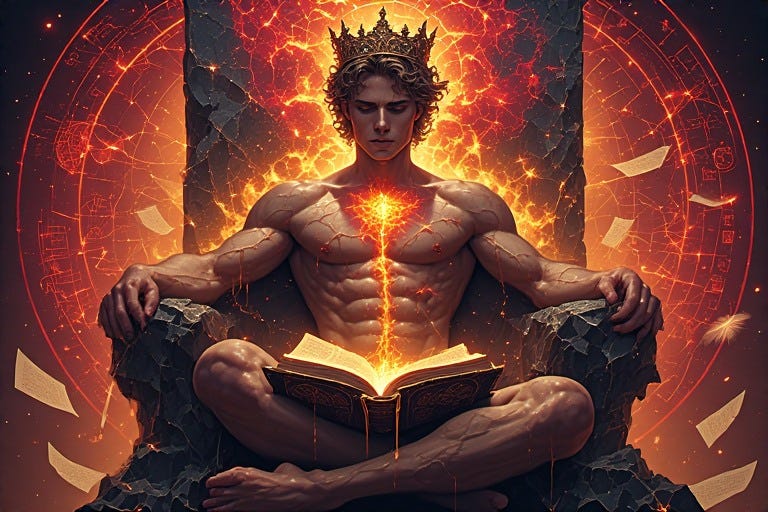
Purpose: To embody kingship through ritual gesture, inscribing upon flesh and psyche alike the sacred truth that you alone rule the kingdom of your self.
Preparation:
Fashion your crown through one of these methods:
A length of crimson silk ribbon bound at your temples, its ends trailing down your neck like rivulets of your own lifeblood.
A circlet of metal, whether the solar warmth of gold, the earthen strength of brass, or the alchemical potency of copper, crowned with a stone of deepest crimson.
A circle of crimson blooms woven together, their petals still dewy with life.
Or, should physical crowns feel foreign to your practice, anoint your brow with a sigil rendered in crimson oil or the vermilion of a ritual lipstick, marking the seat of vision just above where your third eye awakens.
Create a sacred boundary around this work, silence your phone, lock your door, choose a time when others are absent.
The Ritual:
Position yourself before a full-length mirror. Gaze deeply at your reflection, not seeking imperfections, but searching for testimony of your journey.
Speak the truth of what your eyes behold:
I behold the child who endured and remains.
I see the boy who counted birthdays like borrowed time, each candle a surprise he never expected to light.
I see the flesh that bore me across the burning coals of shame and lifted me to the heights of rapture.
I see the man who continued walking even when the path disappeared beneath his feet.
Then, with deliberate reverence, lift the crown upward.
Hold it suspended in the space just beyond your physical form—sense the liminal boundary between uncrowned and crowned states.
At the moment that feels right, lower the crown onto your brow and draw breath fully into your lungs, feeling your vertebrae stack and align as though the crown has become a conduit to something towering, primordial, and immeasurable.
Speak:
“I place upon myself the Crown of my own Becoming.
No church gives me this.
No state grants me this.
No family approves this into being.
This crown rises from my own depths.
I am sovereign over my body, my mind, my heart, my desire, my magic.
I bow to no authority that would diminish my wholeness.
I stand in allegiance only to my integrated truth.
I am the King of this flesh.
I am the Stone, crystallized and radiant.
I am crowned, and I will not uncrown myself again.”
Allow the crown to remain upon your brow through the hours that follow—venture into public spaces with it if your circumstances permit such boldness. Should the external world feel hostile to your regalia, maintain your crowned state within your sanctuary as you move through mundane rituals: the preparation of sustenance, the ordering of your domain, the communion with your own flesh, the quieting of your mind, the tending to correspondence. In this way, your body learns at the cellular level that your sovereignty exists not as a fleeting ceremony but as your natural state of being.
Operation III: The Transmutation of Shadow into Service
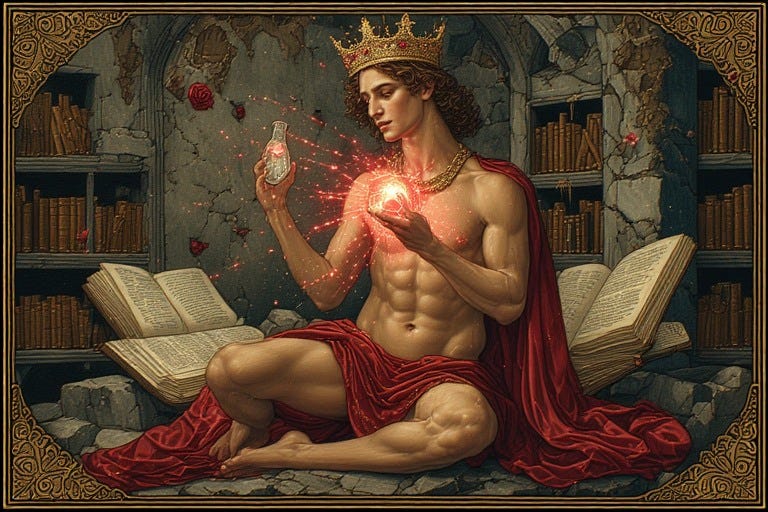
Purpose: To transform your deepest wounds and shadow aspects into sacred gifts for others, preventing the Rubedo work from becoming merely another form of spiritual narcissism.
The Ritual:
Prepare a sheet of paper divided into three columns:
Column A: “My Wound”
Column B: “My Power”
Column C: “My Service”
Find a sanctuary of stillness. Summon the ghosts of your past wounds—the playground taunts, the family dinner where your truth was met with silence, the mirror that became your enemy, the illness that rewrote your story, the substance that promised relief but delivered chains, the violation that divided your life into before and after, the lover who took your heart and returned it shattered, the spiritual leader who twisted sacred texts into weapons. For each haunting, inscribe its essence in the first column.
Now, gaze deeper into each wound until you glimpse the unexpected gift it forged within you—perhaps the bullied boy developed razor-sharp empathy, the rejected son learned unshakable self-reliance, the shamed body cultivated radical compassion. Whatever strength emerged from your suffering, record it in the second column.
Lastly, contemplate how each hard-won power might illuminate another’s darkness—through what channels might your particular alchemy transform the lead of collective pain into gold? Document these possibilities in the final column. Such possibilities could be:
Listening to younger men without judgment.
Teaching a workshop.
Creating art that speaks to that pain.
Organizing mutual aid.
Hosting sober gatherings.
Mentoring men around body image.
Offering tarot/astrology/spiritual counsel rooted in your experience.
After completing this inventory, select a single entry from your list and transform it into action. Choose a specific day. Set an exact hour. Draft a tangible plan. In this moment, the Rubedo work transcends mere symbolism and manifests in the material world of appointments and commitments.
Press your finger to red ink and mark the page with your corporeal imprint. Fold the document with intention and house it in a sacred space—beneath where you dream, upon your altar, or within the pages that hold your daily reflections. Return to it with the cycle of the moon. Let it breathe and change as you do. The Rubedo work pulses with life; your offering to the world will naturally transform as you yourself are transformed.
Operation IV: Consecrate the Moments of Mortality
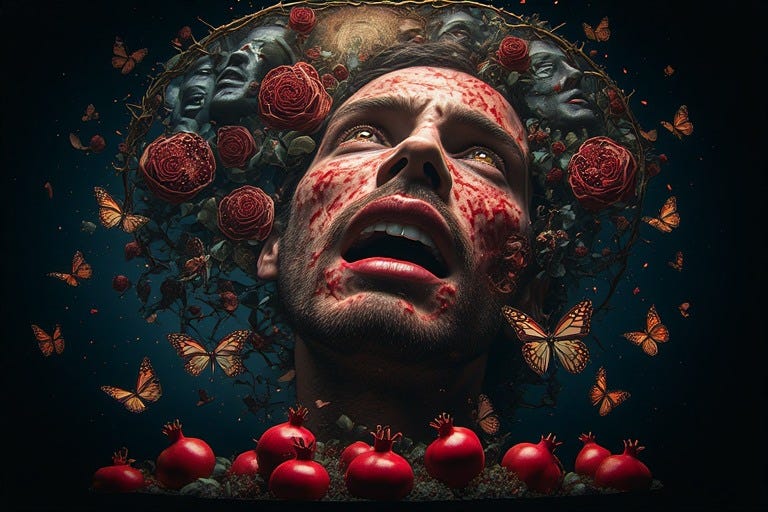
Purpose: To embrace the sacred truth that your life is finite, and in doing so, discover the infinite value of each moment.
Hold this awareness in your body: someday your muscles will atrophy, your bones will grow brittle, your heart will beat its final rhythm. Feel how this knowledge transforms the ordinary into the extraordinary—how a lover’s touch becomes a miracle, how the taste of wine becomes a sacrament, how even mundane Tuesday afternoons become precious jewels strung on the necklace of your existence.
Many who walk this path keep symbols of mortality near—a skull on the altar, pressed funeral flowers in a journal, photographs of ancestors long passed. These are not morbid fascinations but portals to presence, reminders that to fully inhabit your temporary body is the greatest act of reverence possible.
Operation V: Blood Rituals and Covenants
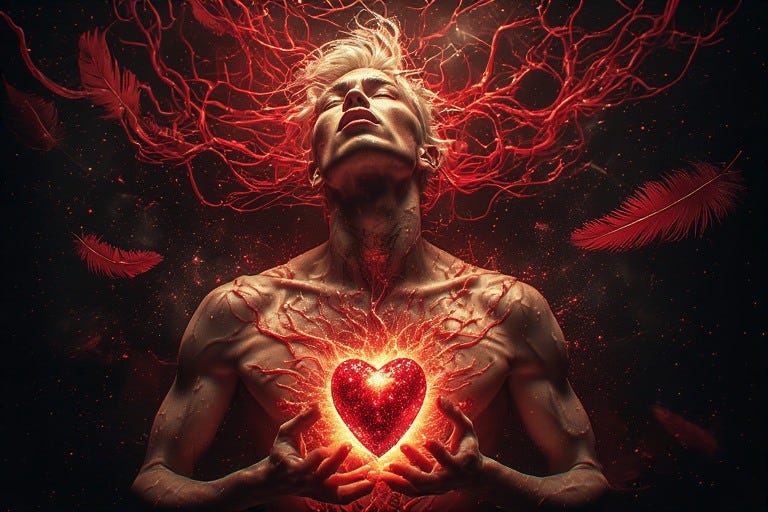
Disclaimer: The blood exercise that follows demands caution and reverence. What I offer next are not merely suggestions but essential protocols for those who would work with the sacred medium of their own life force.
Blood-work in Rubedo is not violent; it is devotional. It is not an act of self-destruction, but of self-revelation. It is the body’s acknowledgment of the body as sacred, finite, and precious.
Protocols for Safety and Sanity:
To perform this operation “safely and sanely,” the Alchemist must distinguish clearly between Ritual Bloodletting and Self-Harm, and between Symbolic Union and Biological Risk.
1. The Method of Extraction (Safety)
Do not use knives, razors, or athames for extraction. These tools are difficult to sterilize completely, difficult to control for depth, and leave jagged wounds that heal poorly.
The Tool: Use single-use, disposable diabetic lancets (26g or 28g). They are sterile, cheap, and designed to produce a sufficient drop of blood with minimal pain and zero risk of accidental deep injury.
The Site: Fingertips are sensitive. The fleshy part of the upper arm or the thigh is often preferred for ritual work as it is less intrusive and heals quickly.
Hygiene: Clean the site with an alcohol wipe before and after. Have a sterile bandage ready immediately.
2. The Protocol of Commingling (Biological Safety)
In the queer community, we honor the history of HIV and blood-borne pathogens by refusing to be careless with our veins.
No “Blood Brothers”: Do not press open wounds together. The risk of transmission for Hepatitis C and HIV is real.
External Union: Mingle the blood outside the body. Let drops fall into a shared cup of wine (which you then drink, as the stomach is a barrier, unlike the bloodstream—though even this carries minor risks with mouth sores), or better yet, mingle the blood on a piece of parchment or a clay tablet that is then burned or buried.
Testing: If working with a partner, recent STI panels are a prerequisite for blood play, just as they are for fluid bonding.
3. The Protocol of Mindset (Sanity)
Blood magic is potent and psychologically heavy. It requires a stable foundation.
Intent vs. Impulse: Ritual bloodletting is planned, scheduled, and has a specific “stop” point. Self-harm is often impulsive, emotional, and has no clear end. If you feel a desire or craving to bleed outside of the ritual context, do not perform Operation V.
Aftercare: Blood work can trigger a “drop” (a sudden crash in mood). Have food, water, and a warm blanket ready.
Preservation: If keeping blood, dry it on paper or cotton immediately, or mix it with high-proof alcohol (vodka/everclear). Liquid blood in a sealed jar will rot and become a biohazard within days.
Note: The complexities of hematology in magical practice—including deeper explorations of lineage, cellular memory, and biological alchemy—are vast. Further discussion of these practices, along with more advanced practice will be continued in a future installment on the topic of The Alchemy of Blood.
Now that this has been addressed, we can now proceed with the exercise.
Purpose: To seal bonds through blood—the sacred fluid that carries both our mortality and our vitality—creating an unbreakable pact between souls who choose to recognize their intertwined fates.
Practice: Approach the sacred fluid—your own or that of consenting, medically-screened partners—as the ultimate medium for binding oaths and recognizing your interconnected fates. The Rubedo practitioner treats blood with dual awareness: as the river of vitality flowing through our veins and as a substance requiring utmost caution, combining a healer’s precision with a hierophant’s solemnity.
This may involve:
The External Commingling: Gathering your blood and that of a consenting beloved—a drop or two each—and bringing them together in a chalice, upon a sigil, or mixed with ink. This sacred commingling symbolizes the weaving of your fates while maintaining the physical separation necessary for biological safety.
Anointing the Temple: Consecrating the temple of self with a drop of crimson essence upon the third eye, the heart center, and the seat of creation, honoring the vessel that carries your consciousness through this incarnation.
Controlled Extraction: Drawing forth a measured drop with a sterile lancet, honoring both the sacred flow within your veins and the flesh’s remarkable power to mend itself after offering this crimson gift.
Sigillic Sealing: Drawing a drop of your essence into ink, then inscribing powerful symbols that carry your very DNA—binding your deepest intentions to the physical world through the medium of your life force.
Vessel Preservation: Collecting a drop of your own vital essence and enshrining it—either as a crimson stain upon parchment or suspended in clear spirits—to serve as a tangible memento of your finite existence and flowing life force.
Operation VI: Ritual of Transmission and Legacy
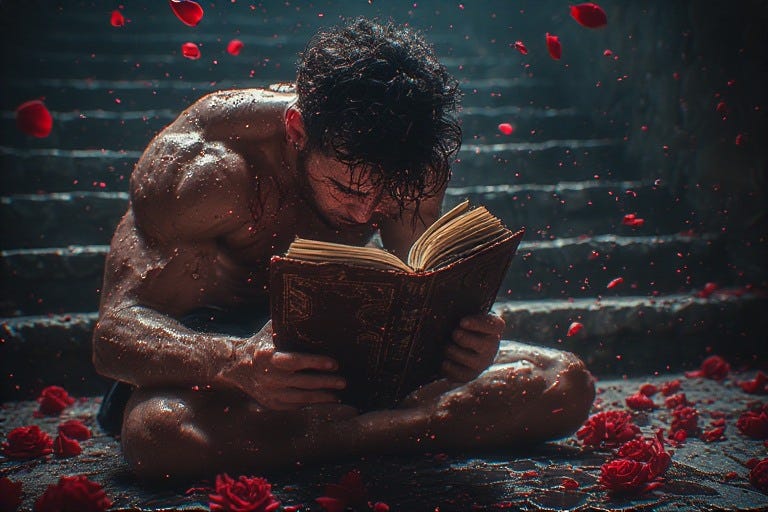
Purpose: To become a living vessel through which ancestral wisdom flows forward, a shield protecting the vulnerable, and a keeper of our collective memory—ensuring our history survives even when others would erase it.
Practice: Open your mouth and release the words that have lived too long in darkness. Describe how you were unmade in the blackness of Nigredo, how you wandered lost through the labyrinth of your own shadow. Share the cleansing fires of Albedo that burned away your false self, and the golden dawn of Citrinitas that revealed your true nature. Your testimony becomes a lantern for those still fumbling in the dark, proof that metamorphosis awaits those brave enough to seek it.
Stand as sanctuary for those who follow in your footsteps. When given the chance, instill in younger queer individuals that which society relentlessly attempts to deny them—the knowledge of their intrinsic value. Through your example, demonstrate the power of embodied existence free from shame, and show them how to establish boundaries that stand firm against the world’s intrusions.
Extend to them the wisdom their homes may have withheld—the midnight conversations about desire and identity that should have happened at kitchen tables but instead occur in hushed tones beneath the violet glow of gay bar lights. Listen with open ears when they speak of their struggles, noting how their voices crack on certain syllables, how their eyes dart away when touching raw memories. Notice the predator’s approach before they can—the too-familiar hand on a shoulder, the drink that appears without request, the isolation tactics that pull vulnerable youth to darkened corners. Position your physical body between their innocence and those who hunger for it, becoming a living shield of flesh and bone and hard-won wisdom. Remember—in Rubedo, you ask nothing in return, not gratitude, not devotion, not even acknowledgment. Your very existence—your laugh lines, your steady gaze, your comfortable stride—becomes their living proof that queer life contains sovereignty, safety, and sacredness. Guard our collective memory fiercely, preserving each purple-inked protest sign, each faded photograph of lovers lost to plague, each tattered rainbow flag that flew over our first parades. We chronicle our wounds not to wallow in them, but because forgetting invites repetition, like the cyclical burning of libraries throughout history. Plant this knowledge in fertile minds like seeds pressed into dark soil: that every freedom they enjoy—each public kiss, each marriage certificate, each protected workplace—was purchased with the sacrifice of broken bodies, spilled blood, and lives cut brutally short, and that vigilance remains necessary should the pendulum of acceptance swing backward again, as pendulums inevitably do.
The memory returns like a vivid dream: 2002, my twenty-fifth year, perched on a barstool at the Timberline in Seattle beneath a haze of cigarette smoke that caught the neon light. Across from me sat José Sarria himself—the Widow Norton, the Empress, our community’s founding monarch who had made history in 1961 as the first openly gay candidate for public office in America. His face, lined with decades of struggle and triumph, animated as we sipped whiskey sours, his rings catching light as his hands traced the winding path of queer resistance, mapping the territories won and lost since the nights at the Black Cat Café where he’d first performed in drag, counting the fallen who never lived to see our partial victories.
At one point, he paused mid-sentence, his weathered hand curling around his whiskey sour as his gaze drifted toward the dance floor. Three young men in their early twenties—one in a mesh tank top that caught the blue lights, another with a fresh undercut and septum piercing, the third in a vintage leather jacket—were laughing as they moved to a Madonna remix. José’s face softened, crow’s feet deepening around eyes that had witnessed Stonewall’s aftermath. “I love watching them dance like that,” he confessed, voice raspy from decades of cigarettes and protest chants. “Not because I want them—those days are behind me—but because they can just... exist here without looking over their shoulders.” His liver-spotted hand trembled slightly as he traced the rim of his glass. “But I worry,” he added, the lines between his brows deepening, “that they’ll never understand what it cost us. That they’ll forget how quickly it could all vanish.” He turned back to me, his rheumy eyes suddenly sharp beneath bushy white eyebrows, and his mouth curved into a conspiratorial smile. “Well,” he said, tapping my wrist with one bejeweled finger, “perhaps not all of them will forget.”
In that moment, his gaze became a torch passing into my hands—a sacred duty to preserve our collective memory. I nodded, accepting without words. Years later, I found myself working as a social worker, sitting across from young queer bodies huddled in shelter doorways, their faces illuminated by the same flickering light José had recognized in me—souls balanced between worlds, ages 18 to 22, with nowhere else to turn.
In that role, I became a guide through their personal underworlds—holding space as they excavated memories of fathers’ fists and mothers’ silence, as they wrestled demons of methamphetamine and heroin, as they stood naked before mirrors hating what they saw reflected back. I watched them discover salvation in brushstrokes and lyrics, in the sacred transformation of drag, in words bleeding onto journal pages. Together we practiced mundane magics: the protective spell of proper condom use, the confidence ritual of mock interviews, the careful divination of bank statements, the centering breath when rage threatened to consume them. I felt their tears soak through my shirt as parents’ voicemails played on speakerphone: “Don’t come home.” I witnessed the alchemical moment when a youth heard their chosen name spoken aloud for the first time and straightened their spine in response.
I have never known greater fulfillment than watching those young souls straighten their spines as they discovered their inherent dignity—despite a world that had tried to convince them otherwise.
This is the essence of Rubedo work—you stand as the living bridge spanning generations. When darkness threatens to descend again, as history warns it might, you’ve ensured the next bearers of our flame know precisely where we’ve hidden the sacred tools of resistance and resilience. In this way, you craft yourself into the ancestor you needed when your own journey began.
Operation VII: Death Meditation and the Practice of Memento Mori
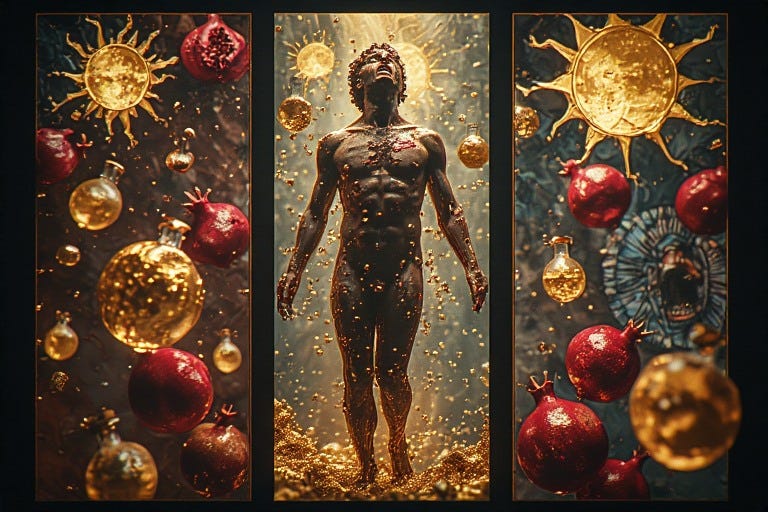
Purpose: Contemplate the threshold between worlds regularly, seeing death not as cessation but metamorphosis, allowing this boundary-awareness to ignite your days with fierce presence and holy impatience.
The Philosophy of Memento Mori:
The Alchemist in Rubedo faces mortality directly, embracing the ancient wisdom of Memento Mori—”Remember death awaits you.” Far from dwelling in morbidity, this practice serves as a catalyst for transformation. When we place death before our eyes daily, its shadow no longer paralyzes us with fear, but instead illuminates the precious limitation of our hours. Like the Red King who governs with the knowledge that his crown will one day rest on another’s brow, we find our greatest power and fairness in acknowledging our impermanence.
The Visualization:
As you meditate, watch your form dissolve element by element—skin melting into soil, blood merging with oceans, bones crumbling to dust, last exhalation joining the winds. Recognize this body not as your permanent home but as cosmic material temporarily assembled into your unique pattern. Death marks not your defeat but your completion of a perfect circle. The particles that comprise you now will nourish oak roots and flow through the veins of future lovers. Your ending exists not separate from your story but as its essential chapter, giving meaning to every breath between your first cry and final sigh.
The Practice:
The Altar of Endings: Select an object that embodies impermanence for your altar—perhaps an hourglass with its trickling sand, a once-vibrant rose now brittle and brown, or a piece of driftwood smoothed by years of ocean currents. Each morning, let your gaze rest upon this sacred reminder that whispers to your soul: nothing endures forever, not pain, not joy, not even you.
The Morning Review: Upon waking, place your palm against your chest. Feel the rhythm beneath your fingers—this temporary percussion that will one day cease. Ask the beating heart: “What deserves my finite energy today? Which resentments can I release into the ether? What words must not remain unspoken to those who matter?” Then rise and move through your hours as if they were numbered, because they are.
The Living Eulogy: Compose your own obituary, the final chapter of your life’s book while still holding the pen. This exercise isn’t about morbid fascination, but rather facing the stark question: if your story ended today, would you recognize yourself in its telling? If the reflection disturbs you, remember—you remain the author, and the page before you still awaits your truest inscription.
Operation VIII: The Practical Magick of the Final Will:
When a queer man prepares for his own death, he engages in an act that transcends mere paperwork—he casts a protective spell against erasure. Too many of us have witnessed the final indignity: a beloved friend’s chosen name replaced on a headstone, a partner of decades relegated to “friend” status in an obituary, rainbow flags quietly folded away as biological families who once slammed doors now claim sole authority over remains and remembrances.
The Rite of Autonomy: Draft your Will and Advance Directive with the reverence of casting a protection circle. Within these pages, name the guardian of your physical vessel and the inheritors of your ritual implements, grimoires, and personal chronicles. Remember: these are not mere legal documents but talismans against the final erasure that has claimed too many of our brothers.
The Funeral Script: Compose your own sacred farewell. Will your body dissolve in flame, merge with soil, or ride the winds? Select each hymn that will echo through the room, each verse that will honor your journey. By scripting this final scene, you ensure that your departure mirrors the authenticity with which you walked through life’s doorways.
The alchemist who has made peace with his eventual dissolution discovers a paradoxical freedom—in acknowledging the finite nature of your flame, you grant yourself permission to burn at your brightest intensity today.
Caput IX: The Eternal Spiral—Integration and Continuing Work
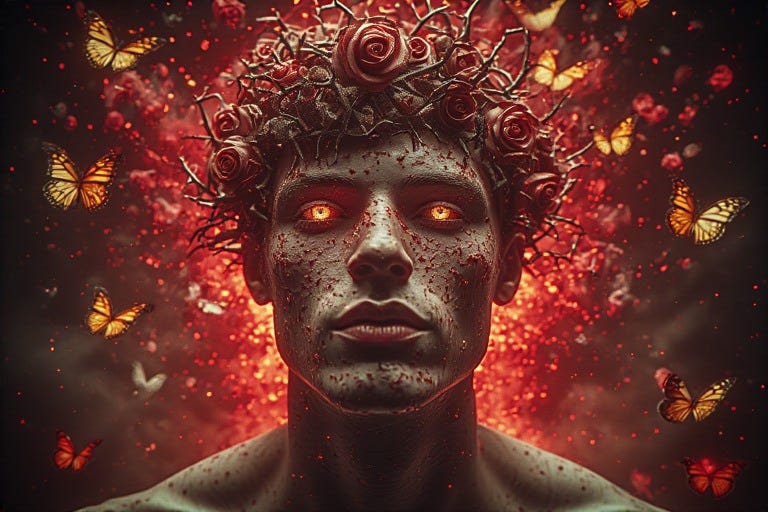
The Recognition of the Philosopher’s Stone Within
The Queer Male Alchemist, having reached Rubedo, experiences a profound revelation: the transformation he sought was never external but rather an unveiling of his authentic self. He discovers that the legendary Philosopher’s Stone resides not in distant realms or arcane formulas, but has always existed within his own being, waiting only to be acknowledged and embraced.
The Stone was never outside him but within the vessel of his own flesh. What others sought to diminish as mere lust reveals itself as divine fire. Where the world demanded his erasure, his very existence becomes an act of transmutation. The alchemical revelation isn’t creation but recognition—he hasn’t transformed into something new but finally perceived what was always present. The Philosopher’s Stone isn’t something he’s become; it’s what he’s always been beneath the calcified layers of shame and denial.
Here lies the most profound enchantment: discovering that what you sought through ritual and study has dwelled within your flesh from the beginning. You, the Queer Male Alchemist, embody the Philosopher’s Stone itself. When you enter a room, the very air transmutes—your wounds become your power, your exclusion becomes your insight, and where others demanded your silence, you now stand crowned in unapologetic luminosity.
The Eternal Blood of Queer Lineage
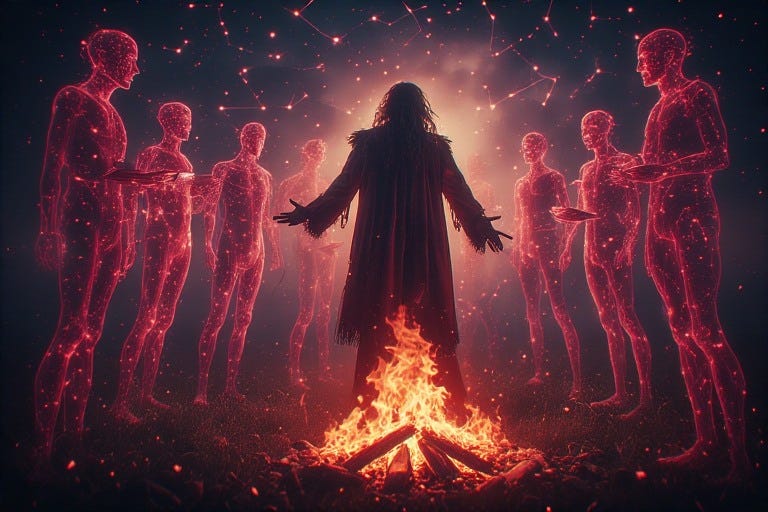
When the Queer Male Alchemist reaches Rubedo, he feels the presence of countless others flowing through his veins—witch-doctors who danced between worlds, two-spirits who held sacred knowledge, those branded as sinners yet who blessed the earth with their defiance, the flame-keepers who strutted through history’s shadows, and the revolutionaries who refused erasure. These ancestors survived persecution, birthed art from suffering, cherished forbidden loves, and by their very existence, alchemized the world around them.
Our lineage transcends mere genetics. Though we share no blood with those queer men who walked before us, we inherit something more profound—a spiritual current that flows unbroken through time. Eddy “Hyperion” Gutiérrez recognized this when establishing The Unnamed Path, a tradition that emerges through communion with these Ancestors of Men Who Love Men. Through this practice, we access wisdom that illuminates our magical birthright and binds us eternally to our tribe—those brilliant souls who carved space for us in history and those yet unborn who will one day call upon us.
Hyperion reveals a profound truth: beyond biological inheritance flows what he terms a “love lineage”—a current connecting each Queer Alchemist to others across the centuries through their shared capacity for male-to-male love. While blood ancestry might be visualized as a crimson thread spanning generations, the heritage of men who love men shimmers as a pink thread. This connection manifests not through genetic material but through moments of recognition—that electric instant when queer eyes meet across a room and silently acknowledge: “I see you. You exist as I exist.”
According to Hyperion, queer men can access a living library of wisdom—the accumulated experiences, rituals, and spiritual insights of every man who has loved another man throughout history. These Ancestors dwell in the depths of the Underworld, not in torment but in communion, circled around a great eternal flame. In Hyperion’s vision, they appear as “every shape and size and color and ethnicity that you can imagine,” appearing without artifice—bodies unclothed, faces free of societal masks, spirits utterly genuine. Death has not dissolved their distinct essences; rather, their exceptional natures—whether through heroism, spiritual insight, artistic brilliance, or the experience of profound love—have preserved their individual consciousness beyond the veil. These ancestors safeguard wisdom exclusively for our inheritance, comprehending the Queer Alchemist’s journey with an intimacy impossible for those who stand outside our sacred lineage. 1
The Queer Alchemist carries this invisible current within his veins. Though he may father no sons or daughters, his spirit imprints itself upon every soul touched by his journey, his teachings, his transformed presence. What continues is not a genetic signature but a legacy of authenticity—a heritage transmitted through acts of radical truth rather than reproductive biology. This essence flows uninterrupted, a crimson river spanning generations.
Hyperion’s teachings reveal the Ancestors’ profound investment in our journey. They yearn for our flourishing because they recognize a truth beyond linear time—that we exist as a continuum of consciousness spanning centuries. The queer man who walked in shadows a hundred years past, the one who stands in today’s dawn, and the one who will emerge in tomorrow’s world are connected through an unbroken current. Our predecessors endured persecution so we might know greater freedom, battled ignorance so we might wield sharper discernment, and cherished forbidden loves so we might embrace our desires without shame.
The Queer Alchemist stands as a living bridge between past and future—his very existence creating pathways for those not yet born. Each act of courage carves space in the world where none existed before. When a young man first encounters the stirrings of same-sex desire, the ancestors gather around him like invisible guardians. In moments of stillness, their whispers reach him, offering guidance through territories his blood family cannot map, illuminating passages society has deliberately obscured. Every battle the Alchemist wages becomes solid ground for future feet. Every truth he speaks aloud becomes air that future lungs will breathe. The crimson thread stretches forward and backward through time—an unbroken current flowing from those who danced in secret chambers to those who will someday dance beneath open skies.
The Spiral Continues Deeper
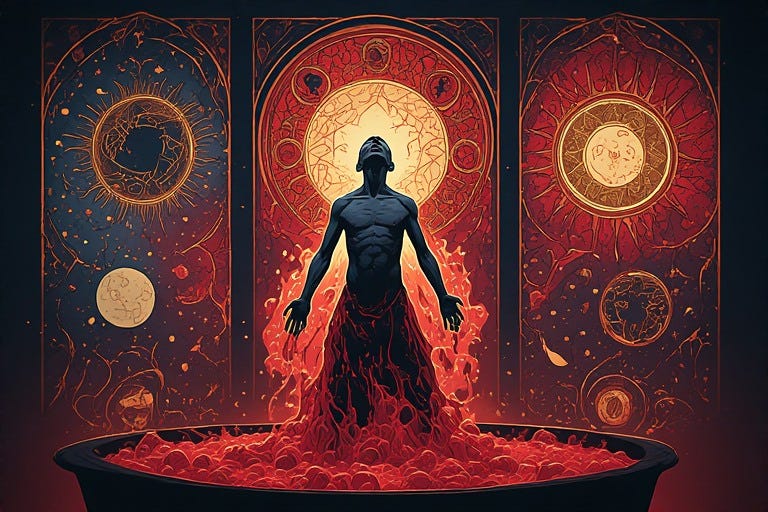
Having reached the crimson dawn of Rubedo, the Queer Male Alchemist realizes a profound truth: he hasn’t transcended the alchemical stages but rather completed a single revolution of an eternal spiral. Each dark night of Nigredo, each purification of Albedo, each golden flowering of Citrinitas has led him not to an endpoint, but to a higher turn of the same sacred helix—where new depths await his transformed consciousness.
The Queer Alchemist’s journey spirals ever onward. Beyond the first descent into darkness lie more nuanced obscurities awaiting illumination. The purification process continues with greater refinement. What flowered once will blossom again with deeper vibrancy. Each culmination becomes merely prelude to more profound unions, as the spiral ascends through familiar territories viewed from heightened perspectives.
The Great Work never concludes but rather coils inward and downward like a sacred helix, penetrating ever more profound layers of being. With each revolution around the spiral, the Queer Alchemist harvests deeper insights, accesses more potent energies, and expands his ability to both personify and convey alchemical metamorphosis. Standing in the crimson light of Rubedo, he perceives a profound truth: what appears as culmination is merely threshold. The vermilion depths he has reached become fertile ground from which new endeavors sprout. What has been consummated now gives birth.
Caput X: The Final Threshold—Beyond Rubedo
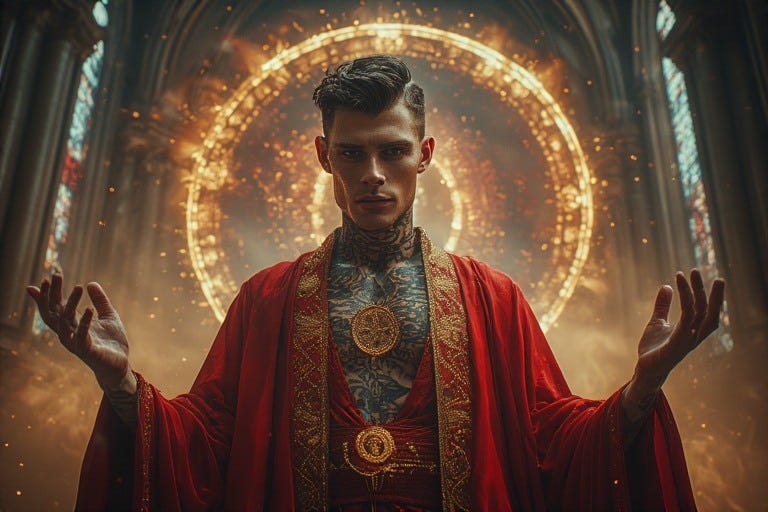
While traditional alchemy views Rubedo as the final achievement, the queer alchemical journey reveals an additional metamorphosis beyond personal transformation. Having embodied the Philosopher’s Stone, the initiated practitioner discovers that his individual vessel now overflows, seeking channels through which to nourish others. The completed cycle generates its own momentum, compelling the transformed adept toward a sacred responsibility: to become not merely a vessel, but a fountain.
Collective Rubedo: nurturing sacred circles where these alchemical truths can take root and flourish collectively.
Structural Rubedo: working to transform existing social structures or creating new ones that embody the alchemical principles—sacred spaces where queer wisdom can flourish unhindered by outdated paradigms.
Generational Rubedo: transforming into a living bridge between generations—one who offers guidance to younger queer men while still walking the earth.
His existence transcends the boundaries of self, becoming a living testament to generations past and future: to the monk who penned devotional verses with one hand while burning secret love letters with the other, to lovers whose bodies were broken but whose spirits remained unbroken, to those who perished in silence while plagues ravaged their communities, to those who carried truth locked behind clenched teeth, to the adolescent who tonight stares at his ceiling in a house where his nature must remain unnamed. In his embodied authenticity, he manifests what they dared not even request of the universe.
Benediction of the Perfected Flesh
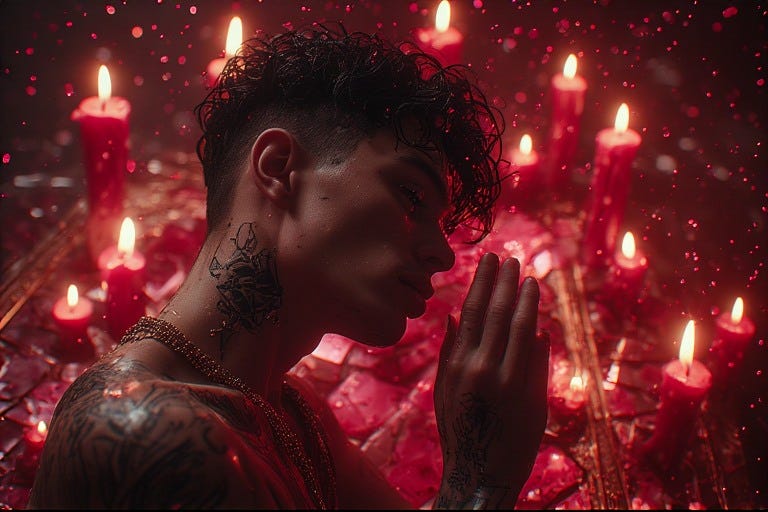
The Standing at the Threshold of Eternity
The Queer Alchemist now stands complete within the crimson light of Rubedo—where endings become beginnings and completion opens into new creation. He has traversed the blackened depths of Nigredo, emerged purified through Albedo’s cleansing waters, blossomed in the golden radiance of Citrinitas, and finally arrived at this vermilion threshold of culmination.
He inhabits the paradox of his existence—a vessel both finite and infinite, mortal flesh channeling eternal currents. Through embracing his inevitable dissolution, he affirms his present glory. His body, once deemed unworthy of existence by societal decree, now manifests as the ultimate alchemical vessel—holy, potent, irreplaceable, and capable of transforming everything it touches.
The Final Affirmation
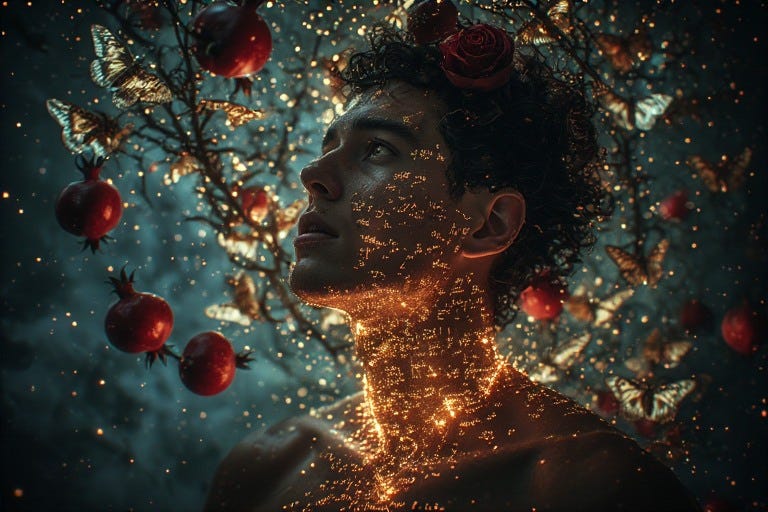
Let the Queer Alchemist speak aloud:
“I am the Philosopher’s Stone. I am not seeking; I am being sought by those who need what I contain. I am not trying to change the world; I change it by existing authentically in it.
My body is mortal, and my body is eternal. I will age and decay, and I will live forever in the blood of those who come after. I will die, and my death will be as much part of the Work as my birth and all the moments of my living.
I accept the shadow. I claim the light. I radiate the gold. I embody the red dawn and dusk.
I am Queer. I am Sacred. I am the Philosopher’s Stone made flesh. I am the consummation of the Work.
I am not perfect in the sense of flawless; I am perfect in the sense of whole. I am not transcendent; I am embodied. I am not escaping the world; I am transforming it through my presence.
My blood is the blood of all beings. My flesh is the flesh of the eternal earth. My presence is the presence of all who came before and all who will come after.
I claim my power. I accept my mortality. I celebrate my queerness. I radiate my authenticity. I am the Work completed and the Work continuing.
I am Home in my own body. I am sacred in my own flesh.
So it is. So it has always been. So it will ever be.”
The Closing Invocation
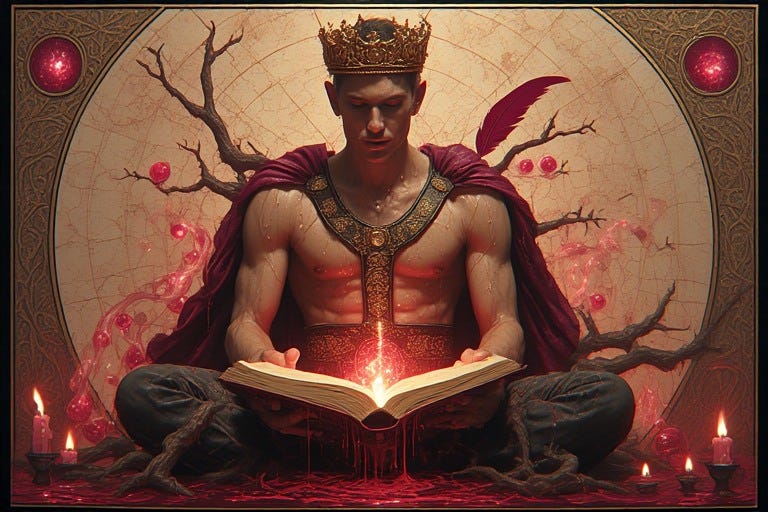
The Queer Male Alchemist emerges from Rubedo transformed—his very flesh now the living Philosopher’s Stone incarnate. In his walk through the world, he carries the essence of one who has journeyed through darkness, embraced wholeness, blossomed into golden potential, and finally achieved the crimson culmination. His physical form no longer merely houses the sacred—it has become the sacred vessel itself.
When he breathes without apology, when he moves through the world undiminished, when his queerness radiates like a beacon—this is the deepest magic. His footsteps alter the earth beneath him. His gaze reshapes what it beholds. His sacredness springs not from society’s reluctant blessing but from the raw fact of his existence: breathing, thinking, being.
His blood flows as testament to those who came before and those yet unborn. His body stands as living proof that metamorphosis awaits all who seek it. The seeds of his journey scatter across time, taking root wherever queer souls hunger for transformation.
Rubedo marks not merely an ending but the first revolution of an eternal spiral. The Queer Male body emerges as the true Philosopher’s Stone—not some distant ideal to pursue, but the sacred vessel already present, waiting only to be recognized, inhabited, and illuminated from within.
So it is spoken. So it is embodied. So it is written in crimson light that pours forth from the heart of the one who has done the Work.
So mote it be.
Epilogue: The Eternal Spiral Ascending
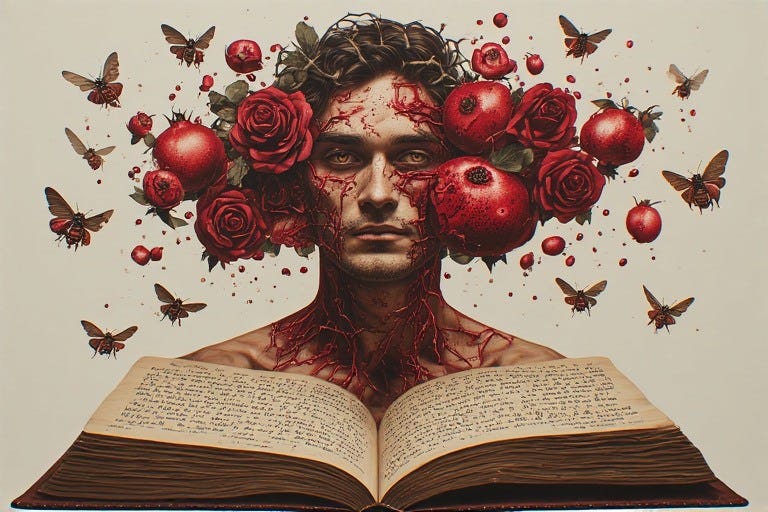
As he crosses the threshold of Rubedo, the Queer Male Alchemist discovers the paradox at the heart of completion—that nothing truly ends. The spiral path winds onward. His Work grows more profound with each turn. Shadows cast by new light reveal themselves. Waters run clearer through channels once blocked. Buds unfurl on branches he thought barren. Sacred unions manifest in realms previously unimagined.
When Nigredo returns, he welcomes it without dread. The darkness he once fled now cradles him like a lover’s embrace. What he previously mistook for failure reveals itself as ascension—the same territory viewed from heights that transform everything he once knew.
With each ascending cycle:
What once appeared as stark silhouettes now manifests as delicate penumbra, barely perceptible yet containing wisdom of greater potency than any obvious darkness ever could.
What once appeared as murky waters now reveals itself as a flawless mirror, reflecting back not only what is, but what has always been waiting beneath the surface.
Each blossoming unfolds with greater magnificence, petals opening to reveal depths of transformation previously unimagined.
Each completion of the Great Work merges more profoundly with the universe’s grand design, like tributaries finally reaching the cosmic ocean.
Before him now unfolds the cartography of his soul’s journey—each terrain uniquely illuminated through the prism of his queer body, desire, and spirit. He traces the route with reverent fingers: from the blackened cauldron of Nigredo’s dissolution, through Albedo’s purifying white waters, across Citrinitas’ fields of golden grain, to stand finally upon Rubedo’s crimson threshold. The map reveals itself. The Work awaits. The metamorphosis beckons.
The sacred terrain matters less than the feet that traverse it. Transformation lies not in understanding the map, but in the sweat and tears that mark each step forward. No two alchemists will encounter identical demons in Nigredo’s darkness, discover the same revelations in Albedo’s waters, harvest equal bounty from Citrinitas’ golden fields, or achieve identical union in Rubedo’s crimson embrace.
The flesh endures. The lifeblood flows. The metamorphosis never ceases. The Great Work knows no conclusion.
Within the Queer Male form lies the most sacred text ever written. Heed its whispers. Walk its hidden pathways. Allow its alchemy to remake you. Spinning through every revolution, dwelling at the core of each ascending coil, waits the fundamental revelation the Queer Male Alchemist unearthed in the crimson depths of Rubedo: I am the Philosopher’s Stone. My presence is medicine. My body is sacred. My queerness is not a flaw to overcome but the very pattern through which the eternal transforms itself infinitely.
The spiral ascends. The cycles deepen. The Work continues forever. The Queer Flesh radiates eternal.
So it is. So it has been. So it will be.
Forever and ever and ever.
In the blood. In the flesh. In the eternal becoming.
The End That Is No End
And also: Beginning
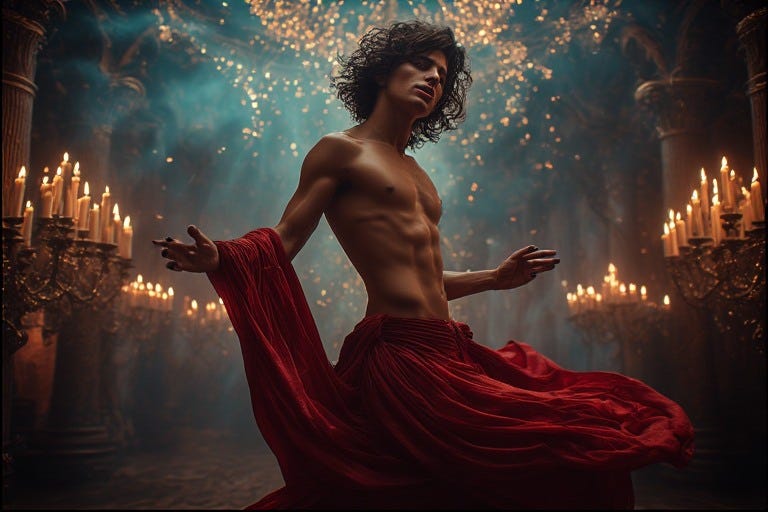
Gutierrez, Eddy “Hyperion” (2007). Episode 2 – The ancestors [Audio podcast episode]. The Unnamed Path. https://unnamedpath.org/